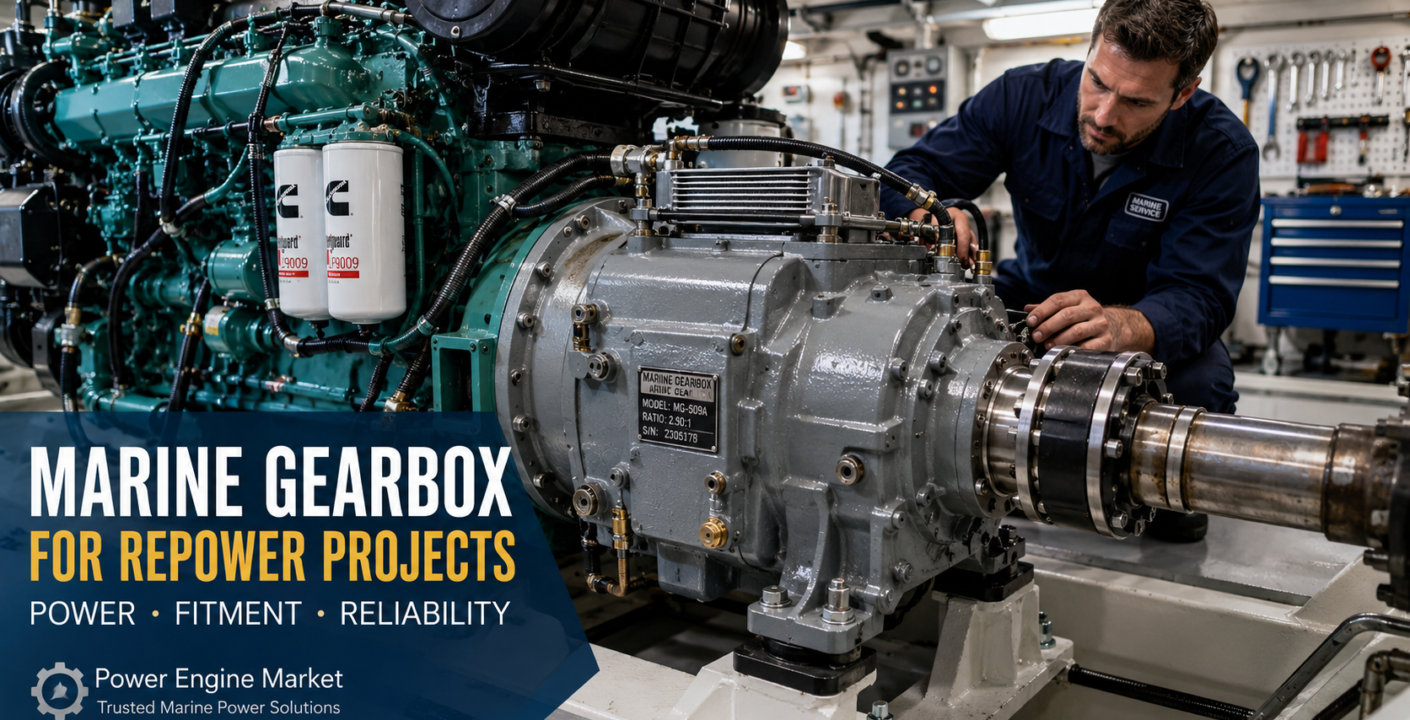
Choosing the right marine gearbox for repower projects sale is one of the most important decisions in any inboard engine upgrade. The gearbox is not just an accessory behind the engine. It is the component that transfers engine power to the propeller shaft, controls forward and reverse movement, reduces engine RPM to usable shaft speed, and protects the rest of the drivetrain when it is correctly matched.
At Power Engine Market, we speak with boat owners, marine engineers, commercial operators, and repower buyers who often begin their project by focusing on the engine alone. That is understandable. The engine is usually the largest purchase, and horsepower is the number everyone notices first. But in real marine propulsion work, horsepower only matters when it is transferred correctly.
A new engine with the wrong gearbox can create poor acceleration, vibration, overheating, clutch wear, shaft stress, propeller mismatch, and reduced reliability. A properly selected marine gearbox for repower projects, on the other hand, helps the engine work within its intended operating range, supports smoother power delivery, and gives the vessel a better chance of performing reliably after installation.
This guide explains what experienced marine gearbox buyers should consider before purchasing a marine gearbox for sale, especially when the gearbox is being used for an engine repower, shaft-drive upgrade, workboat refit, commercial fishing vessel project, or motor yacht propulsion replacement.
What a Marine Gearbox Does in a Repower Project
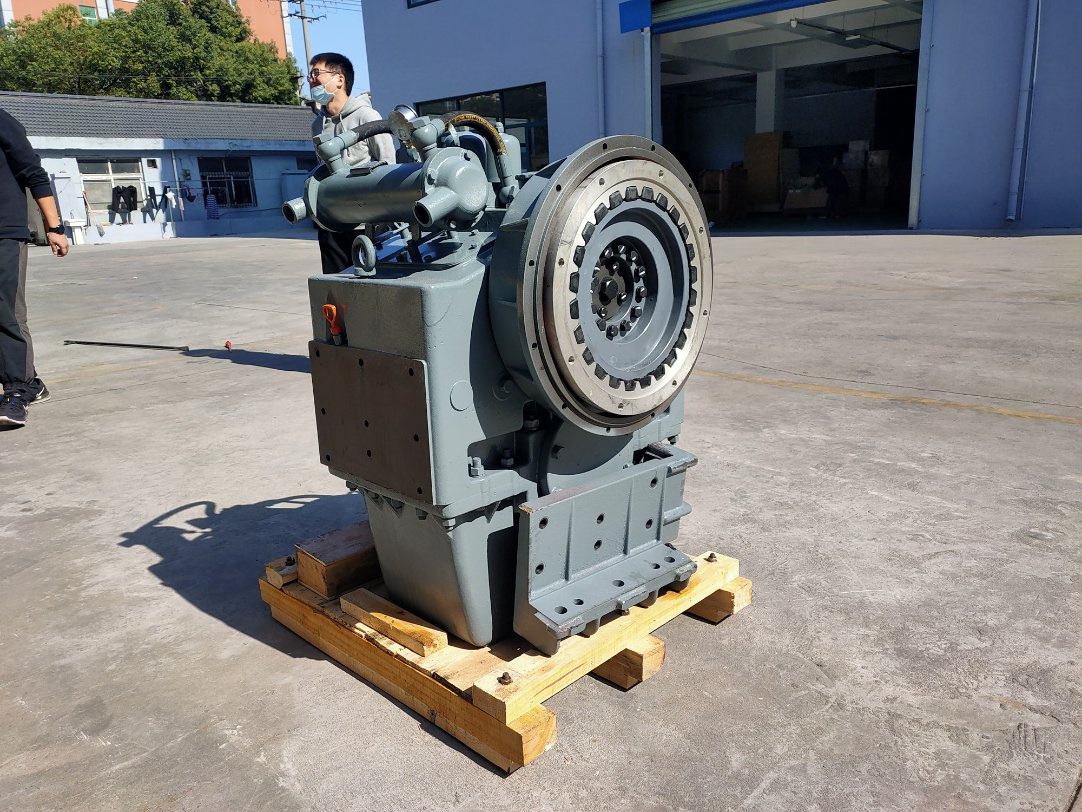
A marine gearbox, also called a marine transmission, is installed between the engine and the propeller shaft. Its job is to receive power from the engine and deliver it to the shaft at the correct speed, direction, and load capacity.
In a typical inboard marine propulsion system, the diesel engine runs faster than the propeller should turn. The gearbox reduces engine speed through a selected reduction ratio. This allows the propeller to operate more efficiently in the water.
The gearbox also provides forward, neutral, and reverse engagement. Without the gearbox, the engine would not be able to control shaft movement properly.
During a repower project, the gearbox becomes even more important because the new engine may not have the same power curve, torque output, RPM range, flywheel housing, mounting position, rotation, control style, or cooling requirements as the old engine. Even if the old gearbox still works, it may not be correct for the new engine.
That is why buyers searching for a marine gearbox for repower projects sale should avoid choosing only by brand name, model number, or availability. The correct gearbox must be matched to the full propulsion system.
Why the Gearbox Should Be Reviewed Before the Engine Is Installed
A common mistake in repower planning is treating the gearbox as a secondary decision. Many buyers select the engine first, then ask later whether the existing gearbox can be reused.
Sometimes the old gearbox can be reused. But it should never be assumed.
A proper repower review should include the gearbox from the beginning. The reason is simple: the gearbox affects propeller speed, shaft compatibility, engine loading, installation alignment, and vessel performance.
If the gearbox ratio is wrong, the engine may not reach its rated RPM. If the gearbox is under-rated, it may overheat or wear prematurely. If the output position does not match the shaft line, the installation may require additional modification. If the rotation is wrong, propeller performance can be affected.
From a vendor’s perspective, this is where many avoidable problems begin. A boat owner may buy a good engine and a good gearbox, but if they are not correctly matched to each other and to the vessel, the final result can still be disappointing.
At Power Engine Market, we always recommend reviewing the engine, gearbox, shaft, coupling, propeller, cooling system, and vessel application together before finalizing a repower package.
A Repower Is the Right Time to Correct Old Drivetrain Problems
Many vessels have small drivetrain issues long before the owner decides to repower. These may include vibration, slow acceleration, warm gearbox oil, difficult shifting, shaft seal wear, propeller mismatch, or an engine that never reaches its proper rated speed.
When a new engine is installed, these older problems often become more obvious.
A repower project gives you the opportunity to correct those issues properly. Instead of forcing a new engine into an old setup, the entire propulsion line can be reviewed. This includes the marine gearbox, engine mounts, shaft alignment, coupling, propeller, control system, and cooling arrangement.
For example, if a vessel previously had an underpowered engine and the owner upgrades to a stronger diesel engine, the old gearbox may not be rated for the new torque. If the propeller is changed, the old reduction ratio may no longer be ideal. If the vessel’s shaft line has existing vibration, installing a new engine without correcting alignment may not solve the problem.
That is why an experienced marine gearbox vendor will not only ask, “What gearbox do you want?” A better question is, “What engine, vessel, shaft, propeller, and duty cycle are we matching this gearbox to?”
Power Matching: Horsepower, Torque, and Duty Rating
When choosing a marine gearbox for repower projects, horsepower is only the starting point.
A gearbox must be rated for the engine’s horsepower, but it must also be suitable for the engine’s torque output and operating duty. Torque is especially important because marine engines operate under heavy load. Unlike road vehicles, boats push against constant water resistance, which places continuous demand on the drivetrain.
A gearbox that may be acceptable in a light pleasure craft may not be suitable for a commercial workboat running long hours under load. A gearbox used in a patrol vessel may experience different demands from one used in a motor yacht. A commercial fishing boat may need a stronger duty rating because it operates with heavier loads and longer working cycles.
When evaluating a marine gearbox for sale, buyers should consider:
Engine horsepower
Engine torque
Rated engine RPM
Gearbox reduction ratio
Pleasure or commercial duty rating
Vessel weight and hull type
Propeller size
Shaft diameter
Expected operating hours
Cooling system capacity
A gearbox should not be selected only because it physically fits. It must be rated for how the boat will actually be used.
Understanding Marine Gearbox Reduction Ratio
The reduction ratio determines how much the gearbox reduces engine RPM before sending power to the propeller shaft. In practical terms, the proper reduction ratio helps the engine and propeller work together instead of fighting each other. When ratio selection is correct, the vessel has a better chance of reaching the right operating range, accelerating cleanly, and moving water efficiently through the propeller.
For example, if an engine runs at high RPM, the gearbox reduces that speed so the propeller turns at a more suitable rate. This is important because propellers must move water efficiently. If the shaft speed is too high or too low for the propeller and hull, performance can suffer.
A wrong reduction ratio can cause several issues:
The engine may fail to reach rated RPM
The vessel may accelerate poorly
Fuel consumption may increase
The engine may run overloaded
The propeller may cavitate or perform inefficiently
Gearbox and engine temperatures may rise
The vessel may not achieve expected cruising speed
During a repower, the old gearbox ratio should always be reviewed. A ratio that worked with the old engine may not work with the new engine, especially if horsepower, torque, rated RPM, or propeller size has changed.
For this reason, marine gearbox ratio selection should be handled together with propeller selection and engine performance planning.
Why the Old Gearbox May Not Suit the New Engine
Many repower buyers ask whether they can keep the old gearbox. The honest answer is: sometimes, but only after proper verification.
The old gearbox may still be in good condition, but condition alone is not enough. It must also match the new engine’s power, torque, RPM, rotation, flywheel housing, drive plate, shaft alignment, and reduction ratio.
A newer engine may produce more torque at different RPM. It may require a different ratio to reach correct propeller speed. It may have different mounting requirements or different electronic control compatibility.
Reusing an old gearbox without checking these details can lead to poor performance or premature failure.
Before reusing an existing gearbox, buyers should confirm:
Gearbox model and serial number
Current reduction ratio
Rated horsepower and torque capacity
Input and output rotation
Oil pressure and shifting condition
Oil condition and service history
Signs of leaks or overheating
Shaft play or bearing noise
Compatibility with the new engine
Cooling system condition
If any of these details are uncertain, it is safer to have the gearbox inspected before installation.
Fitment Details That Must Be Confirmed Before Buying
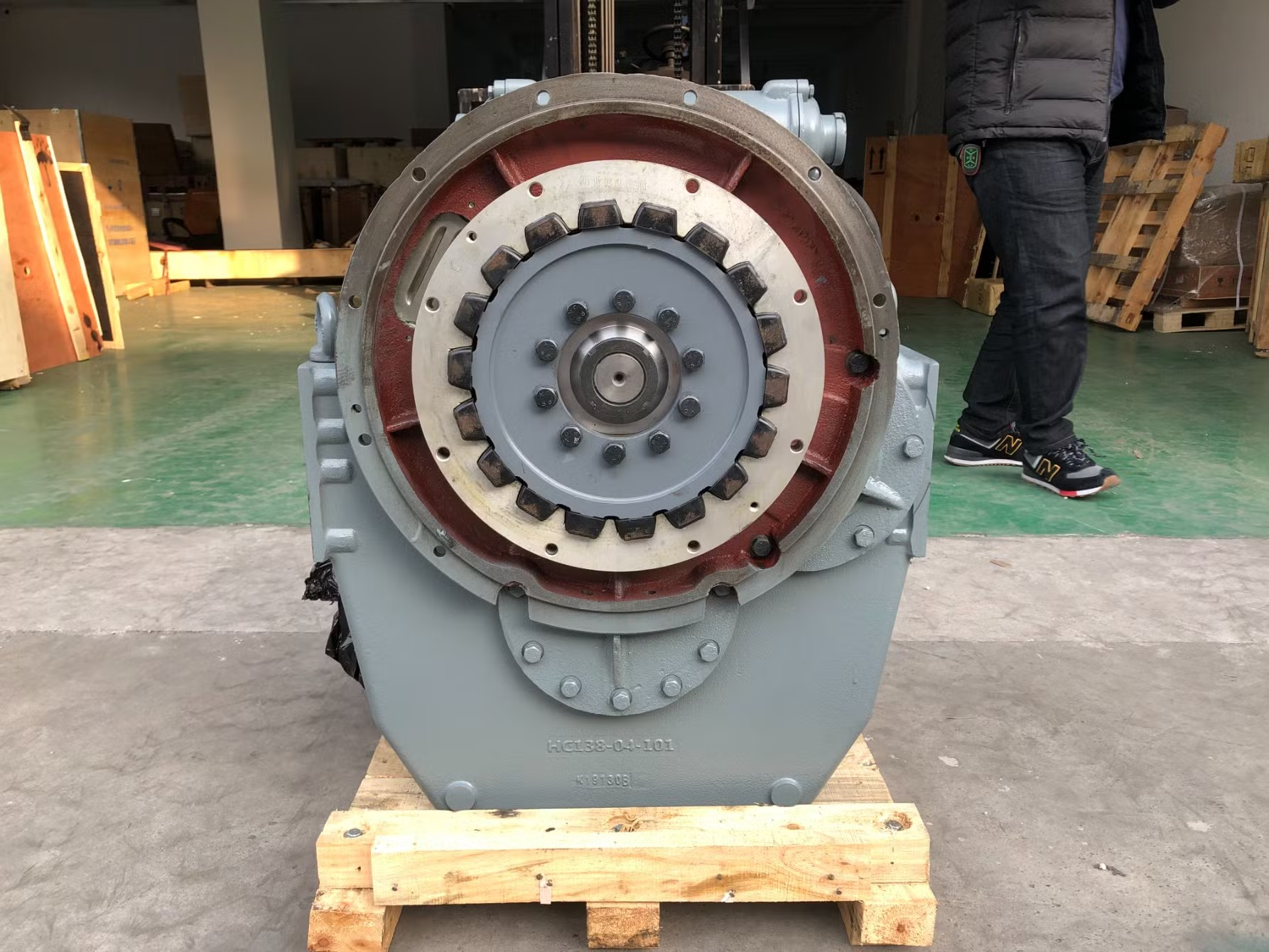
Fitment is one of the most practical parts of selecting a marine gearbox for repower projects sale. A gearbox may be strong enough on paper, but if it does not physically match the engine and vessel, it may not be usable without expensive modifications.
Important fitment details include:
Engine flywheel housing compatibility
SAE housing size
Drive plate compatibility
Input shaft configuration
Output coupling size
Output drop or offset
Mounting points
Gearbox length and height
Engine room clearance
Shaft angle
Control type
Cooling connection sizes
Oil cooler requirements
Access for service and maintenance
For repower projects, photos and measurements are often very helpful. A clear photo of the current gearbox data plate, coupling, shaft line, engine mounts, and engine room layout can make gearbox matching easier.
At Power Engine Market, we encourage customers to share as much technical information as possible before purchase. This reduces guesswork and helps prevent ordering a gearbox that is close, but not correct.
Rotation Direction Should Never Be Guessed
Rotation direction is a small detail with big consequences.
Marine propulsion systems depend on correct rotation between the engine, gearbox, shaft, and propeller. Rotation may be described from the flywheel end or another reference point, so it must be confirmed carefully.
A wrong rotation match can affect propeller performance, twin-engine balance, and drivetrain setup. In some cases, it may require a different propeller or a different gearbox configuration.
Before purchasing a marine transmission for repower projects, confirm:
Engine rotation
Gearbox input rotation
Gearbox output rotation
Propeller rotation
Current vessel rotation setup
Single-engine or twin-engine configuration
For twin-engine vessels, rotation is especially important because port and starboard installations may require matched or opposite rotation arrangements.
This is one of those details where guessing can become expensive. Always verify before buying.
Shaft Alignment and Coupling Compatibility
A good gearbox can still fail to perform properly if the shaft alignment is poor.
Shaft alignment ensures that the engine, gearbox, coupling, shaft, and propeller line are correctly positioned. Poor alignment can create vibration, noise, bearing wear, seal damage, coupling stress, and gearbox strain.
During a repower, alignment should be checked carefully because the new engine and gearbox may sit differently from the old setup. Even small differences in mount height or gearbox output position can affect the shaft line.
Coupling compatibility also matters. The gearbox output flange must match the shaft coupling or be adapted correctly. Shaft diameter, coupling bolt pattern, and spacing should be confirmed before installation.
A marine gearbox replacement should never be treated as a simple bolt-on part unless the alignment and coupling details have been verified.
Reliability Depends on the Complete Setup
A reliable gearbox is not only about brand quality. Reliability depends on correct selection, installation, cooling, operation, and maintenance.
A quality gearbox can fail early if it is overloaded. A correctly rated gearbox can still overheat if the cooling system is poor. A new gearbox can develop problems if shaft alignment is wrong. A strong gearbox can wear prematurely if the wrong oil is used or if oil changes are ignored.
For long-term reliability, buyers should prioritize:
Correct horsepower and torque rating
Correct reduction ratio
Correct duty rating
Proper oil cooling
Proper shaft alignment
Clean oil and correct oil specification
Good engine mounts
Correct coupling match
No overloading
Regular inspection and maintenance
The best reliable marine gearbox for repower projects is the gearbox that matches the real vessel application, not just the engine name.
Cooling and Oil Protection Are Critical
Marine gearboxes work under constant load, which generates heat. That heat must be controlled by the gearbox oil and cooling system.
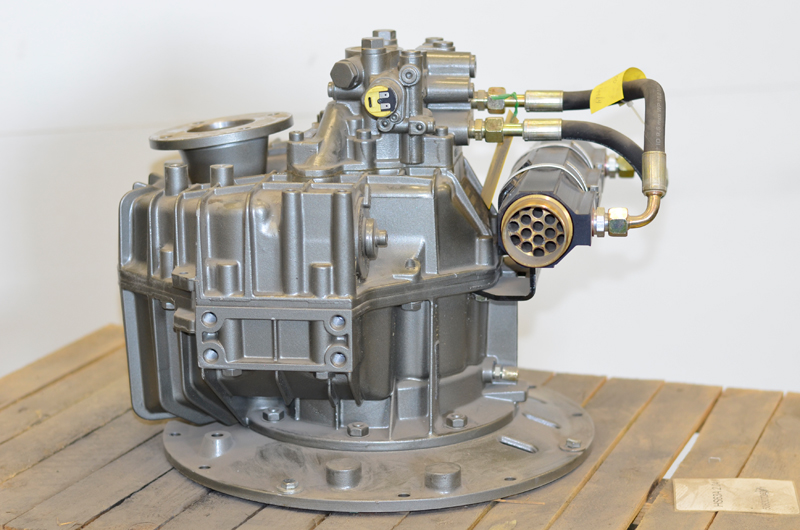
Many marine gearboxes use an oil cooler or heat exchanger to maintain proper operating temperature. A correctly installed marine transmission oil cooler helps protect the gearbox oil, clutch system, bearings, seals, and internal gears from excess heat during heavy or continuous-duty operation.
This is especially important for workboats, patrol boats, commercial fishing vessels, passenger vessels, and other applications that run for long periods under load.
During a repower project, the gearbox oil cooler and cooling lines should be inspected. Reusing old cooling parts without checking them can put the new gearbox at risk.
A gearbox that overheats will not stay reliable, even if it is technically rated for the engine. That is why marine gearbox oil cooling should be part of every serious repower plan.
New vs Used Marine Gearbox for Repower Projects
Both new and used gearboxes have a place, but they do not carry the same level of risk.
A new marine gearbox for repower projects gives buyers more confidence because the condition is known. There is less concern about hidden wear, previous overheating, clutch damage, bearing wear, corrosion, or poor maintenance history.
New gearboxes are especially recommended for commercial vessels, high-value motor yachts, patrol vessels, workboats, passenger vessels, and major repower investments.
A used gearbox may be considered when the budget is limited, when matching an older installation, or when an emergency replacement is needed. However, it should be inspected carefully before installation.
Used gearbox checks should include:
Oil condition
Pressure test if applicable
Shift response
Signs of overheating
Leaks
Corrosion
Bearing noise
Input and output shaft play
Service history
Data plate verification
Before installing a used gearbox, buyers should treat inspection seriously. Basic marine transmission maintenance checks can help reveal problems such as overheated oil, weak shifting, leaks, corrosion, bearing noise, or internal wear before the gearbox is installed behind a new engine.
A low-cost used gearbox can become expensive if it fails after installation. The better value is the gearbox that matches correctly and performs reliably.
Common Marine Gearbox Mistakes Buyers Should Avoid
One of the most common mistakes is buying only by model name. A gearbox model can have different ratios, ratings, and configurations, so the exact specification must be checked.
Another mistake is ignoring torque. Horsepower is important, but torque is often what stresses the gearbox under load.
Some buyers reuse the old gearbox without checking the ratio. This can prevent the engine from reaching rated RPM or cause poor vessel performance.
Others forget cooling. A gearbox may fit and shift properly at first but fail later because the oil cooler is undersized, blocked, or poorly installed.
Buyers should also avoid ignoring rotation direction, shaft coupling, duty rating, and service access.
The biggest mistake is choosing price over fitment. In a repower project, the cheapest gearbox is not always the lowest-cost option long term. If it causes vibration, overheating, poor performance, or early failure, it becomes expensive very quickly.
Vessel Applications That Need Careful Gearbox Matching
A marine gearbox for repower projects sale can be used across many vessel categories, but the correct gearbox depends on the application.
Motor yachts usually need smooth engagement, quiet operation, dependable cruising performance, and good serviceability.
Sportfishing boats need strong acceleration, reliable offshore performance, and confidence under changing sea conditions.
Commercial fishing vessels need torque, durability, cooling capacity, and long-duty reliability.
Patrol boats may need fast response, variable-speed operation, and dependable shifting.
Workboats need heavy-duty construction, service access, and duty-cycle strength.
Passenger vessels need smooth operation, reliability, and safety-focused consistency.
Utility vessels and offshore support boats may require strong cooling, durable gearing, and a rating suitable for demanding use.
Each vessel type places different demands on the gearbox. That is why the vessel application must be part of the selection process.
Marine Gearbox Product Categories Power Engine Market Can Help With
At Power Engine Market, the target product category is marine gearboxes for repower projects, especially for inboard diesel engines and shaft-drive propulsion systems.
Buyers may be comparing:
Hydraulic marine gearboxes
Mechanical marine gearboxes
Shaft-drive marine gearboxes
Heavy-duty marine transmissions
Marine gearboxes for diesel engine repower projects
Marine gearbox replacement options
Commercial marine gearbox solutions
Inboard marine transmission packages
Some buyers need a compact gearbox for a small diesel engine. Others need a stronger gearbox for a Cummins, Volvo Penta, Yanmar, FPT, Baudouin, or other marine diesel engine. Some need replacement transmissions for older vessels, while others need gearbox support as part of a full repower package.
Power Engine Market helps customers approach gearbox selection with the full vessel system in mind.
How Power Engine Market Helps Buyers Choose Correctly
As a marine engine and gearbox supplier, Power Engine Market focuses on practical compatibility, not just product availability.
When helping customers choose a marine gearbox for repower projects, the important details include engine model, horsepower, rated RPM, torque, existing gearbox, reduction ratio, vessel type, shaft size, propeller details, duty cycle, cooling setup, control type, and engine room layout.
This helps reduce the risk of mismatched parts.
A buyer may come looking for “a gearbox,” but what they really need is a gearbox that works with the engine, shaft, propeller, hull, and operating schedule. That is where experienced vendor support matters.
Power Engine Market can also help buyers consider related categories such as marine diesel engines, inboard transmissions, shaft-drive gearboxes, couplings, mounts, controls, cooling components, oil coolers, and repower accessories.
The goal is simple: help customers avoid costly fitment mistakes and choose a gearbox that supports reliable marine propulsion.
Information to Provide Before Buying a Marine Gearbox
Before requesting a gearbox recommendation or quotation, prepare as much information as possible.
Useful details include:
Engine brand and model
Engine horsepower
Engine rated RPM
Torque rating if available
Current gearbox model
Current reduction ratio
Vessel type
Vessel length and approximate weight
Shaft diameter
Propeller size
Current rotation direction
Control type
Cooling setup
Application: pleasure, commercial, fishing, patrol, workboat, passenger, or yacht
Photos are also helpful. A photo of the gearbox plate, engine room, coupling, shaft line, mounts, and cooling connections can make the matching process more accurate.
The more information you provide, the easier it is to recommend the correct marine gearbox for sale.
What Buyers Should Prioritize First
When buying a marine gearbox for repower projects sale, the first priority should always be correct matching.
Start with the power rating. The gearbox must handle the engine horsepower and torque.
Next, confirm the reduction ratio. This affects propeller speed, acceleration, cruising performance, and engine load.
Then confirm physical fitment. The gearbox must match the engine, shaft line, coupling, mounts, and engine room space.
After that, verify rotation direction.
Then review duty rating. A commercial vessel may need a stronger gearbox than a pleasure craft.
Cooling should also be confirmed. The gearbox must have proper oil temperature control for the vessel’s operating conditions.
Finally, choose a knowledgeable supplier. A good vendor helps you avoid expensive mistakes before the gearbox is shipped.
Why the Cheapest Gearbox Is Not Always the Best Value
Marine repower projects can be expensive, so it is natural for buyers to compare prices. But the gearbox is not the place to guess.
A cheap gearbox that is under-rated, incorrectly matched, poorly cooled, or difficult to install can cost more in the long run. It can delay the project, cause haul-out costs, damage connected drivetrain parts, or force the owner to buy another gearbox later.
The better question is not, “What is the cheapest gearbox available?”
The better question is, “Which gearbox gives the correct fit, ratio, duty rating, cooling, and long-term reliability for this vessel?”
That is the buying mindset Power Engine Market encourages for every marine gearbox for repower projects request.
Frequently Asked Questions
What is the best marine gearbox for a repower project?
The best marine gearbox depends on engine horsepower, torque, rated RPM, reduction ratio, shaft size, vessel type, propeller match, duty cycle, cooling setup, and installation layout. The right gearbox is the one that matches the full propulsion system.
Can I reuse my old marine gearbox during a repower?
Sometimes the old gearbox can be reused, but only if it matches the new engine’s horsepower, torque, RPM, rotation, ratio, fitment, and duty rating. It should also be inspected for wear, overheating, leaks, oil condition, and shifting performance.
How do I know what gearbox ratio I need?
The correct gearbox ratio depends on engine RPM, propeller size, vessel weight, hull type, intended speed, and operating load. During a repower, the ratio should be reviewed together with propeller selection.
What happens if the gearbox is too small for the engine?
An under-rated gearbox may overheat, slip, wear clutch components, damage bearings, create vibration, leak oil, or fail early. It can also place stress on the engine, shaft, coupling, and propeller system.
Is a new marine gearbox better for repower projects?
A new marine gearbox often gives better confidence, especially for commercial vessels, patrol boats, workboats, passenger vessels, high-value yachts, and major engine upgrades. Used gearboxes can work, but they should be inspected carefully.
Do marine gearboxes need oil coolers?
Many marine gearboxes require oil cooling, especially in high-load, high-horsepower, or continuous-duty applications. Proper cooling helps protect the gearbox oil, clutch system, seals, bearings, and internal gears.
What details should I send before buying a marine gearbox?
Send the engine model, horsepower, rated RPM, torque if available, current gearbox model, current ratio, shaft diameter, propeller size, vessel type, rotation direction, cooling setup, control type, and application.
Does Power Engine Market supply marine gearboxes for repower projects?
Yes. Power Engine Market helps buyers source marine gearboxes for repower projects, inboard marine transmissions, shaft-drive gearbox options, and related repower components based on vessel type, engine power, fitment, ratio, and application requirements.
Conclusion: Choose the Gearbox Before It Becomes the Problem
A marine repower is a serious investment. The engine matters, but the gearbox is what turns that engine power into usable movement at the propeller shaft.
The right marine gearbox for repower projects sale should match the engine’s horsepower, torque, RPM, ratio, fitment, rotation, cooling needs, vessel duty cycle, and shaft-drive layout. When selected correctly, it supports smoother performance, better reliability, stronger drivetrain protection, and more confidence on the water.
At Power Engine Market, our approach is simple: help customers choose marine gearboxes and repower components based on real vessel requirements, not guesswork. Whether you are upgrading a fishing boat, replacing an old inboard transmission, repowering a workboat, improving a motor yacht, or planning a commercial vessel refit, the gearbox should be treated as a major part of the propulsion system.
Because in marine propulsion, power is only useful when it is transferred correctly.
Next Post: Marine Generator for Liveaboard Boat for Sale: The Smart Buyer’s Guide Before You Order


