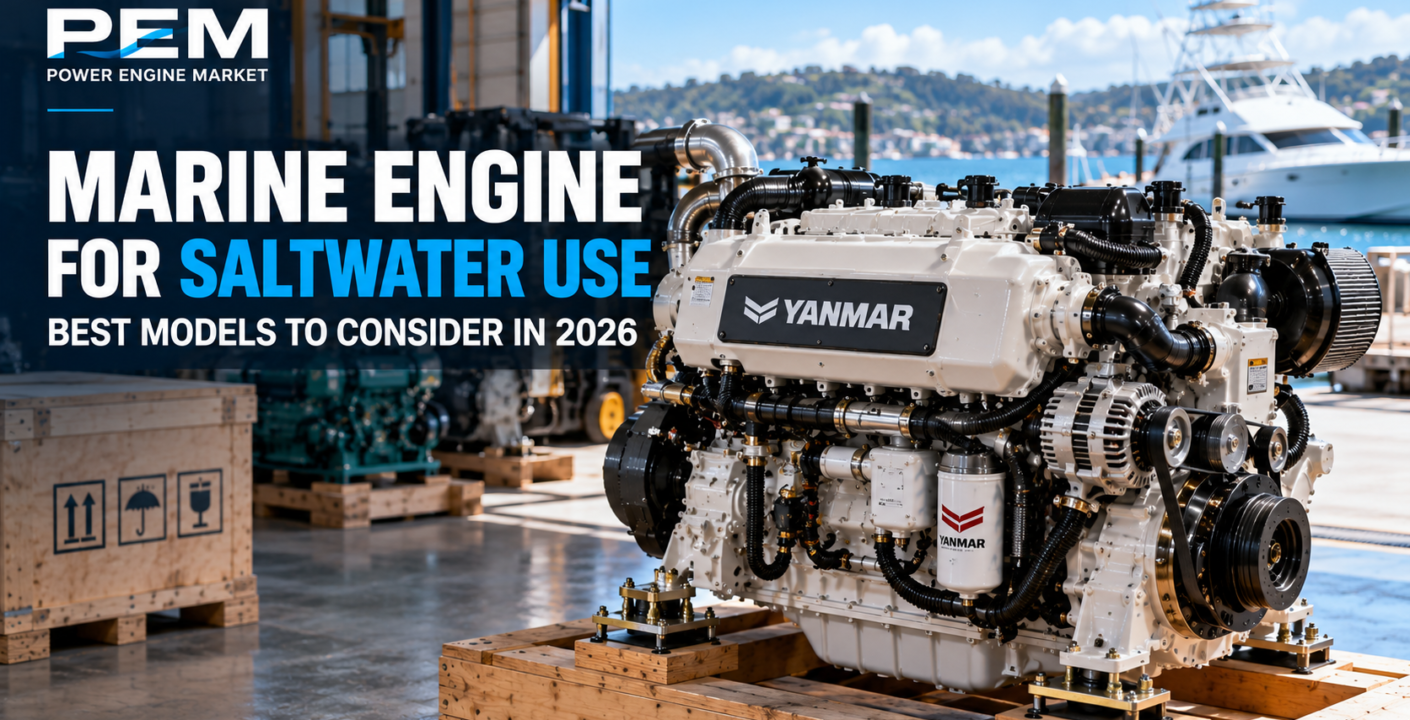
Buying a marine engine for saltwater operation is one of those purchases where choosing the right horsepower is only the beginning.
Saltwater puts equipment through a demanding environment. Corrosion, moisture, cooling-water exposure, electrical connections, exhaust components, long operating periods, and storage conditions can all affect how an engine performs over time.
That is why, when a customer asks us at Power Engine Market for a marine engine for saltwater use for sale, we don’t start by asking, “How much horsepower do you want?”
We start with the boat.
What is the vessel? What engine is currently installed? What RPM does it operate at? What gearbox is connected to it? How much space is available in the engine compartment? Is the boat used recreationally, commercially, offshore, or close to shore? And, if it is a used engine, what do we actually know about its previous service history?
Those questions may take a few extra minutes, but they can prevent a much more expensive mistake later.
This guide explains how to evaluate a saltwater marine engine for sale, which engine families are worth considering in 2026, what to inspect before purchasing, and what information you should have ready when requesting a quotation.
What Makes a Marine Engine Suitable for Saltwater?
A marine engine designed for a saltwater application has to operate as part of a system that is constantly exposed to a challenging environment.
However, “marine engine” does not mean that every engine configuration is automatically appropriate for every boat or saltwater application.
The installation matters.
The cooling arrangement matters.
The maintenance history matters.
And the way the boat is actually used matters.
Corrosion Protection Is More Than a Marketing Phrase
Saltwater and corrosion are inseparable concerns for marine equipment.
The areas worth examining include:
- Raw-water cooling components
- Heat exchangers
- Exhaust components
- Fasteners
- Electrical connections
- Mounting hardware
- Outboard lower units
- Steering and trim components
- Exposed brackets and fittings
For outboards, manufacturers specifically engineer components for the corrosive environment.
Yamaha’s published engineering information describes its outboard lower unit as operating in highly corrosive saltwater environments and says it uses a corrosion-resistant aluminum alloy for the component. Yamaha also describes protective coatings and material selection intended to improve corrosion resistance.
Mercury likewise emphasizes flushing and rinsing saltwater-operated engines after use as part of corrosion prevention.
The practical lesson for a buyer is simple:
Don’t just ask whether an engine can operate in saltwater. Ask how the particular engine and installation are designed and maintained for that environment.
Cooling System Design Matters
The cooling system deserves special attention when evaluating a marine engine for saltwater use.
Depending on the engine, seawater may be used directly in portions of the cooling system, while other designs use a closed engine-coolant circuit with seawater passing through a heat exchanger.
That creates two different areas for maintenance.
The engine’s coolant side has its own requirements.
The raw-water side has its own requirements.
A buyer should understand which components are exposed to seawater and how the manufacturer specifies their inspection and maintenance.
For a used engine, this becomes even more important because the cooling system can provide clues about how the engine was operated and maintained.
Best Marine Engine Types for Saltwater Use in 2026
There is no single engine that is the right choice for every saltwater vessel.
A 25-foot recreational fishing boat, a 40-foot cruiser, and a commercial workboat may all require completely different propulsion systems.
Here are the main categories worth considering.
Saltwater Inboard Diesel Engines
Diesel propulsion is commonly used in:
- Commercial vessels
- Fishing boats
- Workboats
- Cruisers
- Yachts
- Larger recreational vessels
- Long-range vessels
When evaluating a marine diesel engine for saltwater, look beyond horsepower.
Important specifications include:
- Rated horsepower
- Rated RPM
- Torque
- Engine weight
- Overall dimensions
- Cooling arrangement
- Exhaust configuration
- Fuel system
- Transmission compatibility
- Controls
- Electronic requirements
- Intended duty cycle
Two engines can have similar horsepower ratings and still be completely unsuitable as direct replacements for one another.
That’s a point worth emphasizing because it is one of the easiest mistakes to make when shopping online.
Saltwater Outboard Engines
Outboards are widely used on:
- Fishing boats
- Center consoles
- Coastal boats
- Offshore recreational boats
- Smaller commercial vessels
When comparing a saltwater outboard engine for sale, check:
- Horsepower
- Shaft length
- Engine weight
- Mounting requirements
- Controls
- Propeller
- Fuel system
- Electrical requirements
- Corrosion protection
- Service requirements
Yamaha’s published engineering information specifically addresses the corrosion challenges faced by outboard lower units in seawater.
Mercury’s official maintenance guidance recommends flushing and rinsing saltwater-operated engines after use as part of corrosion prevention.
That tells you something important about the buying process: saltwater suitability isn’t only about the engine you buy. It is also about how you maintain it after you buy it.
Marine Gasoline Engines
Gasoline marine engines can make sense for certain recreational applications.
The same compatibility process still applies.
You should verify:
- Horsepower
- RPM
- Physical dimensions
- Fuel requirements
- Controls
- Cooling system
- Exhaust
- Drive or gearbox
- Propeller
- Electrical system
Never assume that an engine is a drop-in replacement simply because its horsepower is similar to the engine being removed.
Used Marine Engines for Saltwater Repowering
A used engine can be an attractive option when the goal is to control acquisition cost.
But the lower purchase price comes with a greater need for verification.
For a used marine engine for saltwater use, request:
- Exact model number
- Serial number
- Operating hours
- Previous application
- Maintenance records
- Current photographs
- Corrosion condition
- Cooling-system condition
- Testing information
- Included accessories
- Warranty information, if applicable
The key question isn’t simply:
“How many hours does it have?”
It is:
“What do we know about those hours?”
An engine used for occasional recreational cruising and an engine that spent years in a commercial saltwater application may have very different histories even if their hour meters show similar numbers.
Marine Engine Models and Families to Consider in 2026
Instead of calling one model universally “the best,” it is more useful to match established engine families to the applications they are designed to serve.
The exact model, rating, emissions configuration, transmission and installation still need to be verified before purchase.
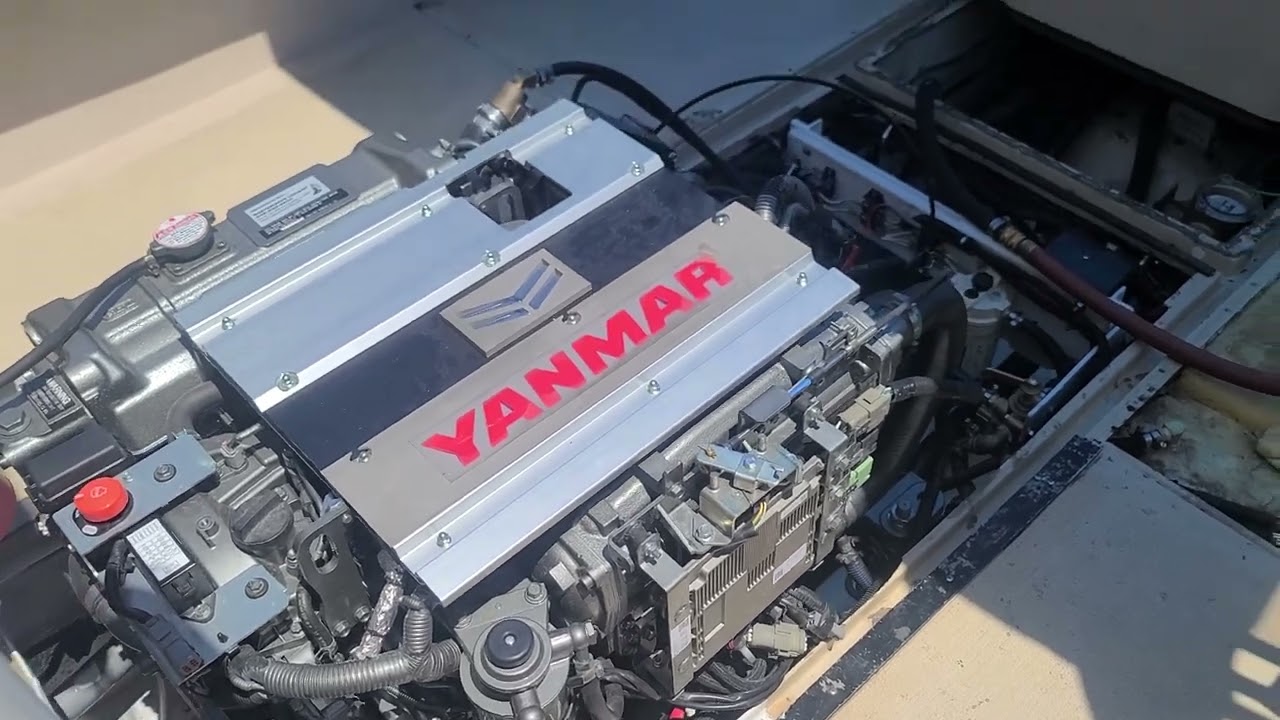
Yanmar Marine Engines
Yanmar currently publishes a marine diesel range covering applications from small craft and sailboats through powerboats and commercial marine applications. Its current international marine lineup includes the YM, JH-CR, 4LV, 8LV, 6LY-CR, 6LF and 6LT families.
The current published range includes examples such as:
- 3YM20 — 21 MHP
- 3YM30AE — 29.1 MHP
- 3JH40 — 40 MHP
- 4JH57 — 57 MHP
- 4JH80 — 80 MHP
- 4JH110 — 110 MHP
- 4LV series — 150–250 MHP
- 8LV series — 320–370 MHP
- 6LY series — 400–440 MHP
- 6LF series — 485–550 MHP
- 6LT series — 500–640 MHP
The value of a broad lineup is that you can start with the vessel requirements instead of trying to make one engine fit every application.
Yanmar also provides a repower-focused process and a dealer/distributor network, which is relevant when evaluating long-term parts and service support.
What to Verify Before Choosing a Yanmar
For a replacement or repower, confirm:
- Exact engine model
- Rated RPM
- Horsepower rating
- Dimensions
- Weight
- Mounting configuration
- Cooling configuration
- Transmission or saildrive compatibility
- Controls
- Required accessories
Those details are more useful than simply saying, “I want a Yanmar.”
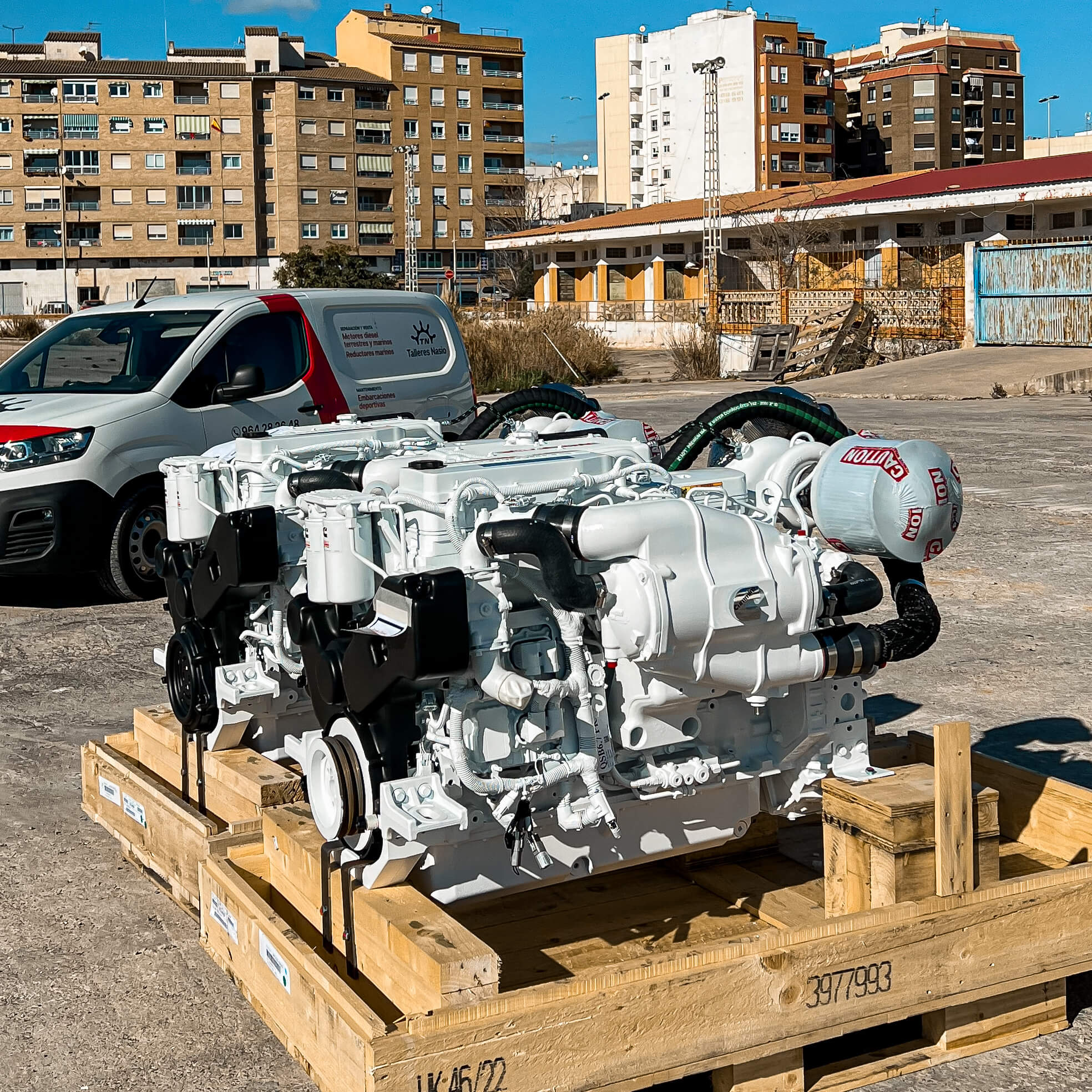
Cummins Marine Engines
Cummins is another major manufacturer to consider for higher-output marine diesel applications.
Cummins’ current recreational marine lineup includes the QSB6.7/QSB7 and QSC8.3 families, among other marine propulsion options. Cummins lists the QSB6.7/QSB7 at 230–550 hp and the QSC8.3 at 490–600 hp on its recreational marine page.
Cummins also highlights applications ranging from fishing boats to yachts and maintains a broad distributor and dealer network.
What Makes Cummins Worth Considering?
For buyers searching for a marine diesel engine for saltwater in a higher-output application, Cummins offers engine families across different power levels and marine applications.
But again, don’t stop at horsepower.
For example, if you’re replacing an existing engine, you should verify:
- Rated RPM
- Engine dimensions
- Weight
- Transmission
- Mounting
- Exhaust
- Cooling
- Electronics
- Controls
- Propeller requirements
The engine should be evaluated as part of the boat’s propulsion system.
Volvo Penta Marine Engines
Volvo Penta’s current inboard shaft range includes D1, D2, D4, D6, D8, D11, D13 and D16 families, with published power ranges extending from small sailboat/inboard applications to substantially higher-output commercial and recreational applications.
The D4 and D6 families, for example, occupy an important portion of the inboard range, with published shaft-drive ratings of 145–320 hp for D4 and 300–480 hp for D6.
Why the Complete Package Matters
Volvo Penta is a useful example of why buyers should think about propulsion as a system.
An engine can be connected to a transmission, drive, controls and propeller system that were selected to work together.
That means a repower isn’t always as simple as removing one engine and putting another in the same space.
You need to determine what else changes.
Yamaha Marine Outboards
For buyers searching for a marine engine for coastal boats, Yamaha outboards may be relevant depending on the vessel.
Yamaha specifically discusses corrosion resistance in its outboard engineering information because lower units operate in environments that can include continuous exposure to seawater.
Yamaha also describes testing its outboards in water tanks that simulate marine operating conditions, including full-throttle testing before shipment.
What to Check
When comparing a Yamaha outboard, verify:
- Exact model
- Horsepower
- Shaft length
- Weight
- Controls
- Propeller
- Rigging
- Electrical requirements
- Mounting configuration
Don’t assume that two engines with similar horsepower are interchangeable.
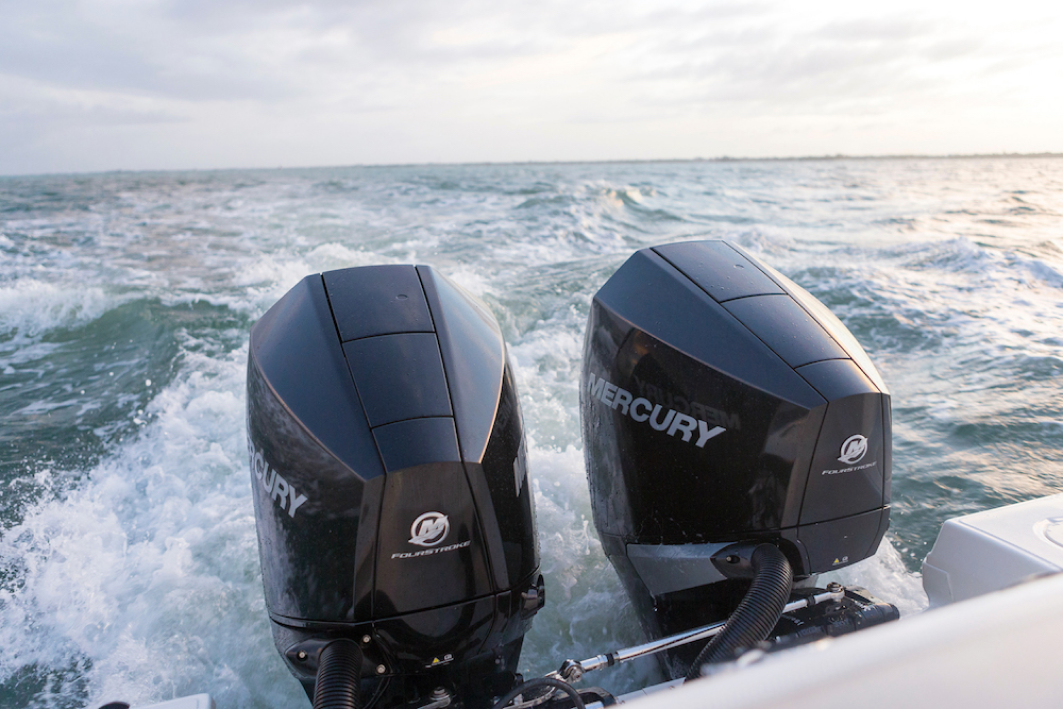
Mercury Marine Outboards
Mercury is another manufacturer worth considering for saltwater outboard applications.
Mercury’s maintenance guidance specifically recommends flushing and rinsing saltwater-operated outboards after use, and it discusses sacrificial anodes as part of corrosion protection.
That provides a useful lesson for buyers:
Saltwater engine selection and saltwater engine maintenance are inseparable.
A good engine still needs the right maintenance routine.
How to Choose the Right Saltwater Marine Engine
This is where a professional engine quotation should begin.
If a customer tells us, “I need a 300-horsepower marine engine,” that gives us one piece of information.
It does not give us enough information to determine whether the engine will actually work for the boat.
Start With the Vessel
Provide:
- Vessel type
- Vessel length
- Vessel weight or displacement, where known
- Intended use
- Recreational or commercial application
- Coastal or offshore operation
- Single or twin-engine configuration
- Existing propulsion arrangement
A marine engine for fishing boat applications, for example, may need to handle a very different duty cycle from an engine used in a recreational cruiser.
Match Horsepower and RPM
Horsepower is only one part of propulsion matching.
Rated RPM matters because it influences the transmission and propeller arrangement.
If your existing engine turns at one rated speed and your proposed replacement operates at a substantially different speed, you need to determine what changes downstream.
That is why the original engine’s data plate is so useful.
Measure the Engine Space
Before ordering, measure:
- Overall length
- Width
- Height
- Mounting points
- Shaft alignment
- Service access
- Removal path
Don’t measure only the space occupied by the existing engine.
Think about the mechanic.
Can the oil filter be reached?
Can the belts be serviced?
Can the starter be removed?
Can the heat exchanger be accessed?
Can the engine actually be removed from the boat if major service is required?
Those practical questions can matter just as much as the engine’s published dimensions.
The Gearbox and Propeller Can Make or Break a Repower
For an inboard vessel, think about the complete propulsion chain:
Engine → Gearbox → Shaft → Propeller
Changing the engine may affect every part of that chain.
Engine RPM
The engine’s rated speed needs to be considered alongside the gearbox.
Gearbox Ratio
A reduction gearbox changes the speed delivered to the propeller shaft.
A simplified relationship is:
Output shaft RPM = Engine RPM ÷ Gear Reduction Ratio
For example, an engine turning at 2,400 RPM with a 2:1 reduction ratio would produce approximately 1,200 RPM at the gearbox output under that simplified calculation.
Actual marine installations require the manufacturer’s specifications and proper engineering.
Propeller Matching
Propeller diameter, pitch, shaft speed, vessel characteristics and engine output all interact.
That means replacing an engine without reviewing the propeller system can create an avoidable problem.
For an inboard repower, don’t treat the gearbox and propeller as an afterthought.
Saltwater Cooling: What You Should Ask Before Buying
Cooling problems are among the last things you want to discover after installation.
Ask the seller or manufacturer:
- What type of cooling system does the engine use?
- Which components are exposed to raw seawater?
- Is there a heat exchanger?
- What maintenance does the raw-water side require?
- What components are included?
- Are there specific installation requirements?
Raw-Water Cooling
Raw seawater can be used in portions of the cooling system depending on the engine design.
That means components exposed to seawater require appropriate inspection and maintenance.
Closed Cooling
A closed cooling arrangement can separate engine coolant from seawater through a heat exchanger.
But don’t interpret that as “no saltwater maintenance.”
The seawater side still has to be maintained.
Heat Exchangers
When inspecting a used engine, ask about the condition and service history of the heat exchanger and associated cooling components.
The cooling system is part of the engine’s condition—not a separate issue.
How to Protect a Marine Engine From Saltwater Corrosion
Even the right engine won’t stay in good condition if maintenance is neglected.
Flush After Saltwater Operation Where Required
Mercury’s official guidance recommends flushing and rinsing saltwater-operated outboards after each use to clear corrosive saltwater and remove salt residue.
Always follow the specific engine’s owner and service manual because flushing procedures vary.
Inspect Sacrificial Anodes
Anodes help protect submerged metal components from galvanic corrosion.
Mercury’s maintenance guidance specifically recommends inspecting anodes and replacing them when sufficiently deteriorated.
The exact parts and replacement requirements depend on the engine.
Watch Electrical Connections
Inspect:
- Battery terminals
- Connectors
- Wiring
- Grounds
- Harnesses
- Electrical components
Salt and moisture can create problems that aren’t immediately obvious.
Pay Attention to the Exhaust
Look for:
- Corrosion
- Leaks
- Damaged components
- Deteriorated connections
If you’re evaluating a used engine, these details can tell you more about its condition than a polished photograph ever will.
New vs. Used Marine Engines
There is no universal answer here.
The right choice depends on the application, budget, availability and amount of verified information.
| Factor | New Engine | Used Engine |
|---|---|---|
| Purchase cost | Usually higher | Potentially lower |
| History | New | Must be established |
| Hours | Minimal | Must be verified |
| Corrosion history | Easier to establish | Requires inspection |
| Warranty | Depends on product | Depends on seller |
| Availability | Depends on model | Can vary |
| Installation | Still requires verification | Still requires verification |
When a Used Engine Makes Sense
A used engine can be worth considering when you can establish:
- Exact identity
- Hours
- Previous application
- Maintenance history
- Current condition
- Testing
- Configuration
- Availability of parts
What We Would Ask About a Used Engine
Before finalizing a purchase, request:
The serial number.
The data plate.
Current photographs.
Operating hours.
Maintenance records, if available.
Previous application.
Any known repairs.
Testing information.
Included accessories.
Warranty terms, if applicable.
If a seller cannot answer basic questions about the engine’s identity or history, slow down before paying.
How Much Does a Marine Engine for Saltwater Use Cost?
A single “average price” isn’t very useful.
The price of a marine engine for saltwater use for sale depends on factors such as:
- Manufacturer
- Model
- Horsepower
- Condition
- New vs. used
- Gearbox
- Controls
- Electronics
- Accessories
- Availability
- Shipping
- Installation
This is why two engines with similar horsepower can have dramatically different total project costs.
Calculate the Complete Project
A more useful way to budget is:
Engine + Required Components + Shipping + Installation = Total Project Cost
For example, a lower-priced engine may require additional spending on:
- Gearbox
- Controls
- Wiring
- Mounting
- Propeller
- Exhaust
- Cooling components
- Freight
So don’t compare the first number you see.
Compare the complete package.
Buying a Marine Engine Online: What to Verify
Buying marine equipment online can give you access to a much broader inventory.
It also means you have to become more deliberate about verification.
Verify the Exact Model
Don’t rely on a generic listing such as:
“300 HP marine diesel engine.”
Ask for the exact model number.
Verify the Serial Number
This is especially important for used equipment.
Ask for Current Photographs
Request:
- Full engine
- Identification plate
- Front
- Rear
- Port side
- Starboard side
- Gearbox
- Major connections
- Any visible corrosion
Confirm What’s Included
Ask whether the quotation includes:
- Engine
- Gearbox
- Starter
- Alternator
- ECU/ECM
- Wiring harness
- Controls
- Gauges
- Displays
- Mounting hardware
- Accessories
Never assume that everything visible in a photograph is included in the sale.
Warranty: Read the Actual Terms
A statement such as “warranty included” isn’t enough.
Ask:
- How long is the warranty?
- What components are covered?
- What is excluded?
- Who handles claims?
- Is labor covered?
- Does the warranty apply to your location?
- Are there application restrictions?
Warranty coverage can differ by manufacturer, product, application and region.
For example, Volvo Penta currently publishes separate marine leisure and commercial warranty structures with different coverage periods depending on product and use.
Cummins likewise provides marine warranty and support information for its engine products.
The important lesson is to read the warranty for the specific engine and application, rather than assuming a generic warranty statement applies to your purchase.
Marine Engine Shipping: Don’t Leave It Until the End
Marine engines are heavy, valuable pieces of equipment.
Shipping should therefore be part of the buying conversation from the beginning.
What Determines Shipping Cost?
Freight pricing can depend on:
- Weight
- Dimensions
- Packaging
- Crating
- Pickup location
- Destination
- Freight class
- Delivery requirements
- International customs
- Port handling
What Should a Marine Engine Quote Show?
A professional quotation should make the following clear where confirmed:
- Engine price
- Shipping fee
- Shipping method
- Estimated dispatch time
- Estimated transit time
- Included equipment
- Warranty terms
If the shipping cost has not been confirmed, it should be identified as pending rather than presented as a made-up figure.
That protects both the buyer and seller.
A Practical Marine Engine Buying Checklist
Before you approve an order, go through this list.
Vessel
- What boat is the engine going into?
- What is the vessel’s size?
- What is the intended use?
- Is it coastal or offshore?
Existing Engine
- Manufacturer?
- Model?
- Serial number?
- Horsepower?
- Rated RPM?
- Engine dimensions?
- Weight?
Drivetrain
- Gearbox?
- Gear ratio?
- Shaft size?
- Propeller specifications?
- Existing controls?
Installation
- Engine-room dimensions?
- Mounting locations?
- Exhaust arrangement?
- Cooling connections?
- Electrical requirements?
- Service access?
Purchase
- New or used?
- Hours?
- Maintenance history?
- Current photographs?
- Testing?
- Warranty?
- Included accessories?
Delivery
- Destination?
- Shipping fee?
- Freight method?
- Dispatch estimate?
- Transit estimate?
If you can answer those questions, you’re in a much stronger position to compare engines.
How Power Engine Market Approaches Marine Engine Selection
At Power Engine Market, the most useful quotation isn’t necessarily the one that gets a customer a number fastest.
It’s the one that gives the customer enough information to understand what they’re actually buying.
That starts with the application.
When a customer provides the existing engine model, serial number, photographs, gearbox details, vessel information and delivery location, we can work from concrete information rather than assumptions.
For a marine engine for saltwater use for sale, we recommend providing:
- Vessel type
- Vessel length
- Intended use
- Current engine
- Engine model
- Serial number
- Horsepower
- RPM
- Gearbox
- Gear ratio
- Engine-room dimensions
- Photographs
- Location
- New or used preference
If some information isn’t available, say so.
It’s better to identify an unknown than to guess.
That principle matters especially when discussing fitment, shipping, warranty and used-equipment condition.
Frequently Asked Questions
What is the best marine engine for saltwater use?
There isn’t one engine that is universally best for every saltwater vessel.
The appropriate engine depends on the boat, horsepower requirement, RPM, cooling system, gearbox, propeller, installation and intended operating conditions.
Are all marine engines suitable for saltwater?
Marine engines are designed for marine applications, but individual configurations and maintenance requirements differ.
Verify the manufacturer’s application information and the specific engine’s cooling and corrosion-protection requirements.
Are diesel engines good for saltwater boats?
Diesel engines are widely used in recreational, commercial and workboat applications.
The correct engine depends on the vessel and duty cycle.
Can I use a used marine engine in saltwater?
Yes, provided its condition and configuration are properly verified.
Pay particular attention to corrosion, cooling components, hours, maintenance history and previous application.
What is the best marine engine for a fishing boat?
That depends on the fishing boat.
A small recreational fishing boat and a commercial offshore fishing vessel can require very different propulsion systems.
Start with vessel size, weight, operating profile and horsepower requirements.
How do I protect a marine engine from saltwater corrosion?
Follow the manufacturer’s maintenance instructions.
Depending on the engine, this can include flushing, rinsing, inspecting anodes, maintaining cooling components, protecting electrical connections and addressing corrosion promptly.
Mercury, for example, specifically recommends flushing and rinsing saltwater-operated outboards after use.
Does a marine engine come with a gearbox?
Not necessarily.
Some engines are sold separately, while others may be available as complete propulsion packages.
Always confirm exactly what is included in the quotation.
How much does a saltwater marine engine cost?
Pricing depends on the engine model, horsepower, condition, configuration, accessories, availability, shipping and installation.
What information should I provide when requesting a marine engine quotation?
The most useful information includes your vessel type, current engine model and serial number, horsepower, RPM, gearbox information, dimensions, photographs, intended use and delivery location.
Final Thoughts: Buy the Engine That Fits the Boat
The biggest mistake you can make when buying a marine engine for saltwater use for sale is treating the engine as an isolated product.
It isn’t.
It’s part of a propulsion system.
The vessel determines the application.
The application helps determine the engine.
The engine affects the gearbox.
The gearbox affects shaft speed.
The shaft speed affects propeller selection.
And all of it has to fit physically, electrically and mechanically into the boat.
That’s why we recommend slowing down before ordering.
Get the data plate.
Take the photographs.
Measure the engine compartment.
Confirm the RPM.
Identify the gearbox.
Check the propeller.
Ask about cooling.
Ask about corrosion.
Verify the serial number on used equipment.
Confirm what is included.
Then calculate the delivered cost, including shipping.
Manufacturers such as Yanmar, Cummins, Volvo Penta, Yamaha and Mercury offer different marine propulsion solutions across different applications. Their published product information also shows why buyers need to evaluate the exact model and configuration rather than relying on brand names alone.
For Power Engine Market customers, that’s the approach worth taking.
If you’re looking for a marine engine for saltwater use for sale, send us the vessel details, current engine information, photographs, gearbox specifications and delivery location.
The more accurately we understand the existing setup, the easier it becomes to compare the right marine engines instead of simply comparing horsepower numbers.
Because when you’re buying an engine for a boat that has to perform in saltwater, the right fit is worth far more than the cheapest listing.
Next Post: Limited Time Marine Engine Sale Online: Best Deals to Buy Now


