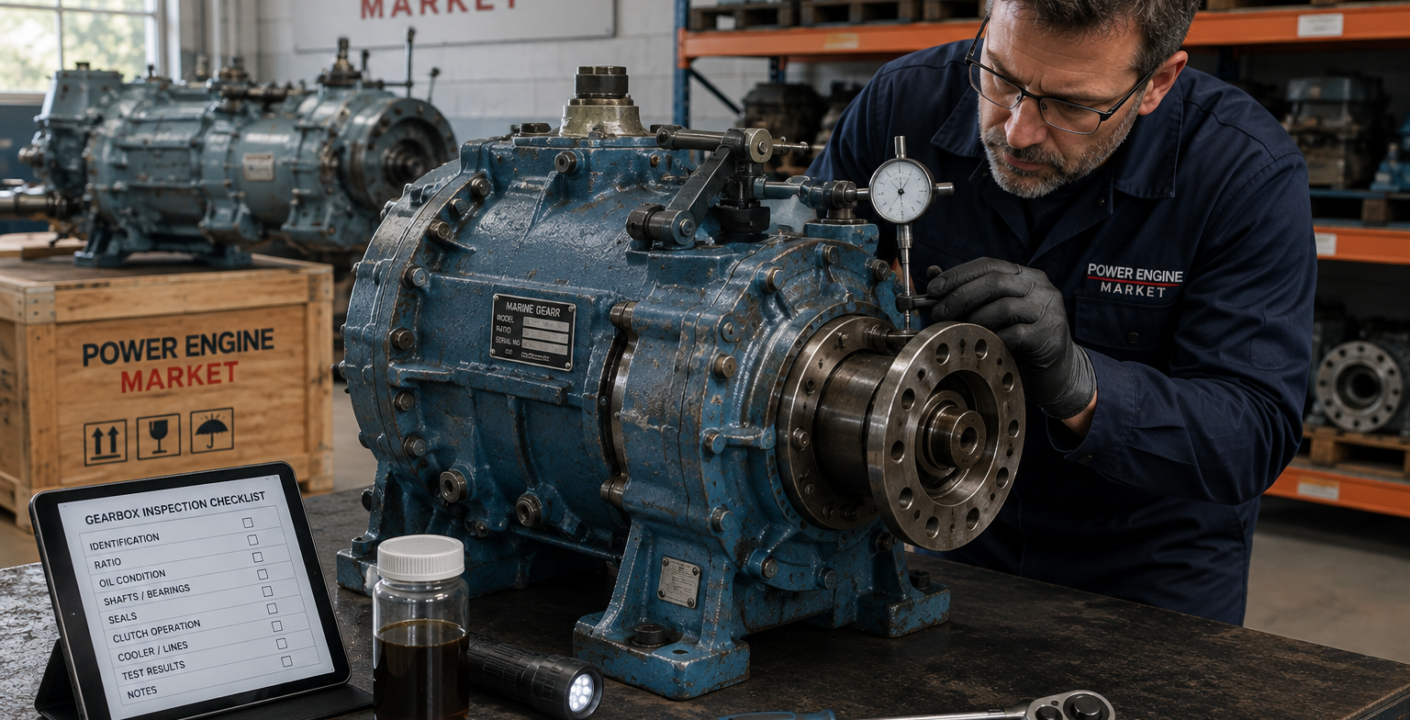
A certified used marine gearbox for sale can be an excellent way to replace a failed transmission, keep an older propulsion package in service, or reduce the cost of a repower.
But only if you know exactly what you are buying.
That sounds obvious, yet one of the most common mistakes we see when buyers compare used marine transmissions is focusing on the wrong things first.
The gearbox looks clean.
The paint is fresh.
The price is attractive.
The seller says:
“It has been tested.”
Great.
But tested how?
Was the gearbox simply shifted by hand?
Was it run without load?
Was oil pressure checked?
Was it inspected internally?
Was it load-tested?
Who inspected it?
What documentation exists?
And most importantly:
Is that gearbox actually correct for your engine, reduction ratio, duty cycle, shaft, propeller, controls, and vessel?
At Power Engine Market, we believe a good used marine transmission should be evaluated on four things:
Identity → Condition → Compatibility → Evidence
If any of those four are missing, you are taking on more uncertainty.
This guide explains exactly what we recommend checking before buying a used Twin Disc, Technodrive, ZF Marine, Advance, or other marine transmission.
The goal is simple:
Buy a gearbox you understand—not a gearbox you merely hope is good.
What Should You Check Before Buying a Used Marine Gearbox?
Before buying any used marine transmission for sale, confirm as much of the following as possible:
- Manufacturer
- Exact model
- Serial/specification number
- Forward reduction ratio
- Reverse ratio
- Previous engine
- Previous vessel/application
- Rated power and RPM compatibility
- Duty classification
- Operating hours, if documented
- Service history
- Repair/rebuild history
- Housing condition
- Corrosion
- Oil condition
- Water contamination
- Input shaft condition
- Output flange condition
- Bearing/shaft play
- Seal leakage
- Clutch engagement
- Cooling system
- Controls
- Test method
- Warranty or return terms
Then confirm that the gearbox actually fits your intended propulsion system.
That final point matters just as much as condition.
A mechanically healthy gearbox can still be completely wrong for your boat.
What Does “Certified Used Marine Gearbox” Actually Mean?
This is where we want buyers to slow down.
The phrase certified used marine gearbox sounds reassuring, but it is not automatically a universal manufacturer-defined condition grade.
Ask four questions:
Who certified it?
What inspection was performed?
What testing was performed?
What documentation supports the claim?
Unless a gearbox is specifically covered by a manufacturer or recognized remanufacturing program, do not automatically assume “certified” means:
- Manufacturer-certified
- Factory-rebuilt
- Remanufactured
- Dynamometer-tested
- Load-tested
- Supplied with a factory warranty
Those are separate claims and should be documented individually.
Certified Used vs Used
A normal used gearbox has previously been operated.
That tells you almost nothing about its current mechanical condition.
An inspected or certified-used gearbox should ideally have a defined inspection process behind the condition description.
Certified Used vs Rebuilt
A rebuilt transmission has undergone repair or internal work.
An inspected used gearbox may not have been opened internally at all.
Those are not the same thing.
Certified Used vs Remanufactured
Remanufacturing is usually a much more extensive process.
For example, ZF describes major transmission overhaul as involving replacement of wear parts, measurement of major components against tolerances, technical updates, and subsequent testing. ZF also states that both function and load tests may be performed depending on requirements.
That is very different from somebody wiping down a used gearbox, shifting it through forward and reverse, and calling it remanufactured.
The Rule We Recommend
Never buy the label. Buy the process behind the label.
If somebody says a gearbox is certified, ask what the certification actually means.
Why Buy a Used Marine Gearbox?
Used equipment is not automatically inferior equipment.
There are several situations where it can make excellent economic sense.
Lower Initial Cost
This is the obvious reason.
A correctly identified and serviceable used gearbox may cost considerably less than a new replacement.
But there is an important difference between:
cheap purchase price
and
low total installed cost.
If the gearbox is wrong, worn, or poorly matched, the savings can disappear quickly.
Keeping an Older Propulsion Package Together
Some older engines are still working perfectly well.
The problem may simply be that their original marine transmission has failed or is difficult to source new.
In that situation, a matching used replacement marine gearbox can help avoid unnecessary changes to:
- Bellhousing
- Damper plate
- Engine mounts
- Output coupling
- Shaft geometry
- Controls
Repower and Restoration Projects
Older yachts and commercial boats often have limited engine-room space.
A gearbox with the same or very similar dimensions can sometimes reduce installation work.
Again:
similar dimensions do not replace compatibility checks.
Commercial Operations
Commercial operators may also consider used or rebuilt gearboxes depending on availability, downtime, economics, and maintenance strategy.
But the more demanding the duty cycle, the more carefully the gearbox condition and manufacturer rating should be verified.
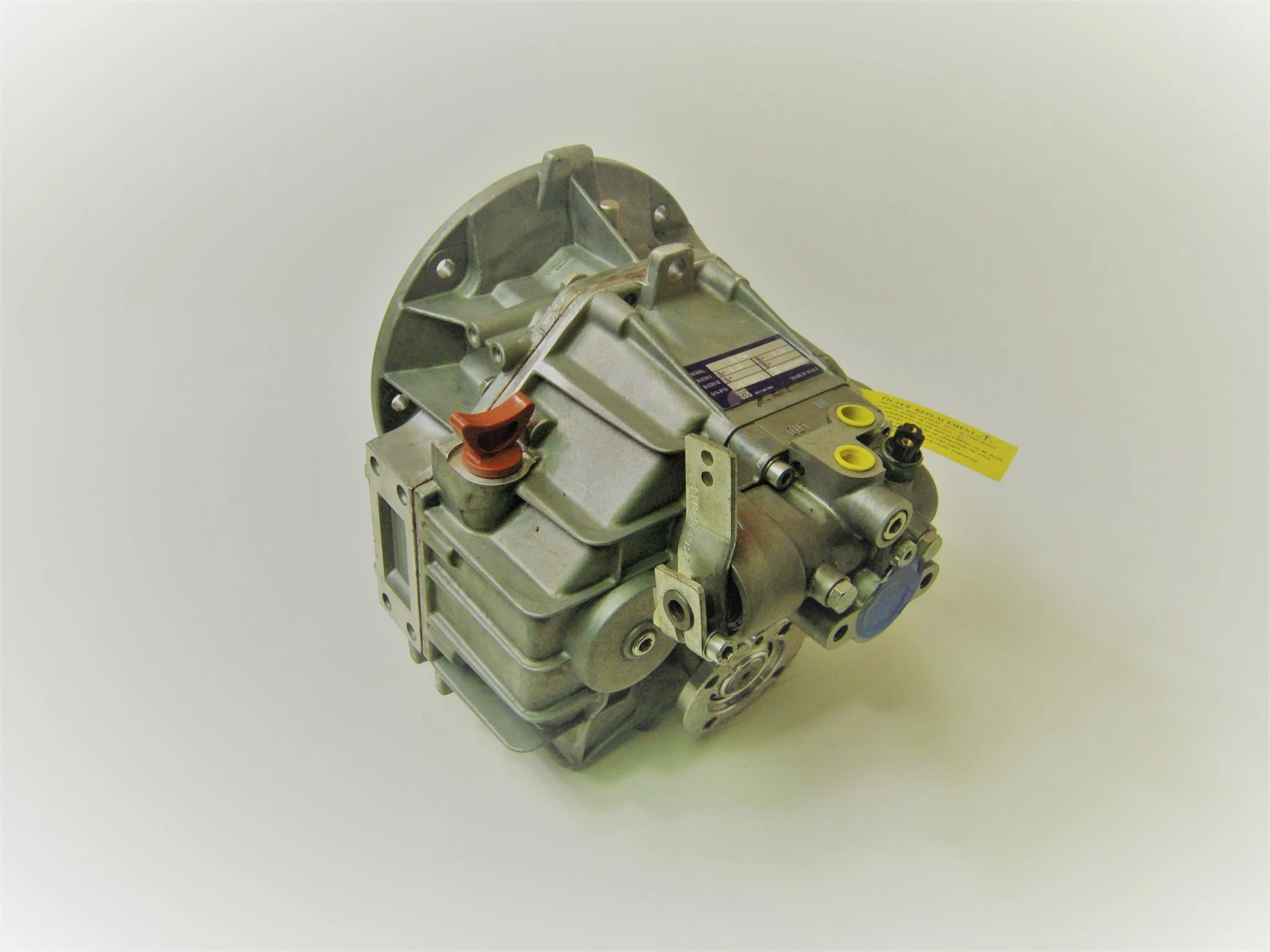
Start With the Identification Plate
Before you inspect the paint, inspect the identity.
A marine gearbox nameplate may show:
- Manufacturer
- Model
- Serial number
- Specification number
- Forward ratio
- Reverse ratio
- Other manufacturer-specific information
Take a clear photograph.
This is often the single most useful thing you can send Power Engine Market when asking for replacement help.
Why Model Alone Isn’t Enough
Take the Technodrive TMC40P as an example.
The same gearbox family has been offered with different forward reduction ratios.
So:
TMC40P 2.00:1
and
TMC40P 2.60:1
are not the same propulsion specification.
The gearbox housing may look nearly identical.
The name may be almost identical.
The output speed is not.
Why the Serial Number Matters
Where manufacturer records are available, a serial number may help establish build information or specification history.
Even where it doesn’t unlock a complete factory record, it still gives you another piece of identification evidence.
What If the Nameplate Is Missing?
Treat the purchase more cautiously.
You may need to investigate:
- Casting numbers
- Ratio markings
- Housing configuration
- Input arrangement
- Output flange
- Shift/control design
- Manufacturer documentation
A missing plate does not automatically mean the gearbox is bad.
But unidentified equipment carries more risk.
Never Identify a Used Gearbox by Appearance Alone
Marine transmissions from related families can look extremely similar.
We have seen how easy it is for buyers to say:
“That looks exactly like mine.”
and assume the job is done.
It isn’t.
Verify:
Model → Ratio → Serial/Spec → Housing → Input → Output → Controls → Dimensions
A photograph can help identify a gearbox.
It should not be the only thing you rely on.
Verify the Reduction Ratio Before You Buy
This is one of the easiest ways to turn a good gearbox into a bad purchase.
Suppose your existing transmission is:
2.00:1
and the used gearbox you’ve found is:
2.60:1
At 3,000 engine RPM:
2.00:1 → approximately 1,500 shaft RPM
2.60:1 → approximately 1,154 shaft RPM
That is a major change in propeller-shaft speed.
Basic Ratio Formula
Use:
Shaft RPM = Engine RPM ÷ Forward Reduction Ratio
For reference:
| Engine RPM | Ratio | Approx. Shaft RPM |
|---|---|---|
| 3,000 | 1.50:1 | 2,000 |
| 3,000 | 2.00:1 | 1,500 |
| 3,000 | 2.50:1 | 1,200 |
| 3,000 | 2.60:1 | 1,154 |
| 3,000 | 3.00:1 | 1,000 |
Changing ratio may affect:
- Propeller diameter
- Propeller pitch
- Engine loading
- Acceleration
- Vessel speed
- Propeller efficiency
This is why used marine gearbox reduction ratio should be verified before condition becomes the main conversation.
A perfectly healthy 2.60:1 gearbox may still be wrong if your propulsion system requires 2.00:1.
Ask What Engine the Gearbox Previously Ran Behind
This is another useful part of the history.
Ask for:
- Engine manufacturer
- Engine model
- Power
- Rated RPM
- Vessel type
- Operating duty
Why?
Because the previous application gives you context about how the gearbox may have lived.
A private yacht may accumulate relatively few annual hours.
A fishing or charter vessel may accumulate far more.
But don’t make the mistake of assuming:
commercial = bad
or
low-hour recreational = good.
Maintenance matters.
Alignment matters.
Correct oil matters.
Temperature matters.
Propeller loading matters.
A properly maintained commercial transmission can outlive a poorly maintained pleasure-craft gearbox by a very large margin.
ZF has publicly discussed marine transmissions in demanding service accumulating tens of thousands of hours, illustrating why hour count alone does not tell the entire condition story.
How Many Hours Are Too Many for a Used Marine Gearbox?
There is no universal answer.
If someone tells you:
“Never buy a marine gearbox above 2,000 hours.”
ask where that rule came from.
Actual transmission life depends on:
- Gearbox design
- Duty cycle
- Engine power
- Engine RPM
- Propeller loading
- Lubrication
- Operating temperature
- Alignment
- Service intervals
- Previous failures
- Water contamination
- Storage conditions
A gearbox with documented higher hours and excellent maintenance may be a better purchase than a “low-hour” unit with no records and years of poor storage.
Hours are evidence. They are not a verdict.
Ask for the Service History
Documentation creates confidence. Service history should be treated as evidence, not decoration. ZF’s official marine driveline diagnosis, maintenance and overhaul services separate diagnosis, spare parts, maintenance concepts, repairs, overhauls, retrofit and repowering into distinct service activities, which is exactly why a buyer should ask what work was actually performed rather than accepting a vague claim that a gearbox was “serviced.”
Ask whether there are records for:
Oil Changes
Was the correct manufacturer-approved lubricant used?
Were service intervals followed?
Seal Replacements
Were seals replaced as preventative maintenance or because of a leak?
Bearings
Has bearing work been performed?
Clutch Repairs
Has the gearbox had cone-clutch or hydraulic clutch work?
Cooler Service
Has the oil cooler been cleaned, pressure-checked, repaired, or replaced?
Previous Rebuilds
If somebody says:
“The gearbox was rebuilt two years ago,”
ask:
- Who rebuilt it?
- What parts were replaced?
- Was the housing inspected?
- Were shafts measured?
- Were bearings replaced?
- Were clutches replaced?
- Was it tested afterward?
ZF’s own marine aftermarket offering distinguishes diagnosis, maintenance, repairs, overhauls, retrofit and repowering as separate service activities—which is exactly why buyers should not assume every repaired gearbox received the same level of work.
Ask Why the Gearbox Was Removed
This is one of the simplest questions and one of the most useful.
Maybe:
- The vessel was repowered
- The owner changed ratios
- The engine failed
- The boat was dismantled
- The gearbox was upgraded
- The transmission itself failed
Those stories are not equal.
If the seller cannot tell you why the gearbox was removed, that doesn’t automatically make the gearbox bad.
But it increases uncertainty.
Inspect the Gearbox Housing
Start with the structure.
Cracks
Look closely around:
- Mounting feet
- Input/bellhousing area
- Output housing
- Bolt bosses
- Cooler connections
Weld Repairs
A welded housing needs explanation.
Ask:
What happened?
Who repaired it?
Was alignment or structural integrity checked afterward?
Mounting Feet
Look for:
- Cracking
- Damage
- Bent areas
- Improvised repairs
Threads and Fasteners
Damaged threads and incorrect fasteners can suggest previous careless service.
None of these things automatically prove catastrophic internal damage.
But they give you clues about how the gearbox has been treated.
Corrosion: Where It Is Matters
Marine equipment lives around water and salt.
Some surface oxidation is normal on older equipment.
Severe corrosion is another story.
Pay close attention around:
- Shaft seals
- Input shaft
- Output flange
- Cooler fittings
- Oil connections
- Mating surfaces
- Structural housing areas
If you are researching how to inspect a used marine gearbox, don’t just ask:
“Is there corrosion?”
Ask:
“Where is the corrosion, and what does it affect?”
Fresh Paint Is Not Mechanical Evidence
A used gearbox can be professionally stripped and refinished.
There is nothing wrong with that.
But fresh paint can also hide clues such as:
- Previous corrosion
- Oil staining
- Weld repairs
- Hairline cracks
- Surface damage
Ask for older photographs if available.
Remember:
A paint booth cannot rebuild a bearing.
Inspect the Gearbox Oil
Oil condition can tell you useful things.
Look for:
- Metallic debris
- Water
- Emulsification
- Burnt smell
- Excess contamination
- Incorrectly low fluid level
Where a magnetic drain plug is fitted, examine accumulated material.
But don’t overinterpret one oil sample.
Fresh oil may have been installed shortly before sale.
Oil analysis is useful evidence.
It is not a complete transmission inspection.
Water Contamination Deserves Serious Attention
Water may enter a marine gearbox from:
- Cooler problems
- Seal issues
- Condensation
- Poor storage
- Direct water exposure
Milky or emulsified oil deserves further investigation.
If the gearbox has suffered significant water contamination, internal steel components and bearings may have been exposed to corrosion even if the housing still looks good.
Inspect the Input Shaft
Look for:
- Worn splines
- Corrosion
- Shaft damage
- Seal wear
- Abnormal movement
Then verify that the input arrangement works with your engine and damper plate.
A healthy input shaft that doesn’t match your damper is still the wrong input shaft.
Inspect the Output Flange
Check:
- Bolt holes
- Flange face
- Corrosion
- Seal area
- Abnormal movement
- Damage from previous coupling/alignment issues
Then compare the flange with your existing shaft coupling.
This is one of those details buyers often discover too late.
Check Bearing and Shaft Play
Evaluate both input and output shafts for unusual radial and axial movement.
Do not use a universal internet tolerance.
Acceptable movement depends on gearbox design.
Manufacturer specification should be used where available.
Excessive movement can point toward:
- Bearing wear
- Shaft wear
- Internal damage
But measurements need proper interpretation.
Inspect for Leakage
Look around:
- Input seal
- Output seal
- Case joints
- Selector shaft
- Hydraulic fittings
- Oil lines
- Cooler connections
A little old staining is not necessarily the same as an active leak.
What matters is understanding:
where it came from and whether the problem was corrected.
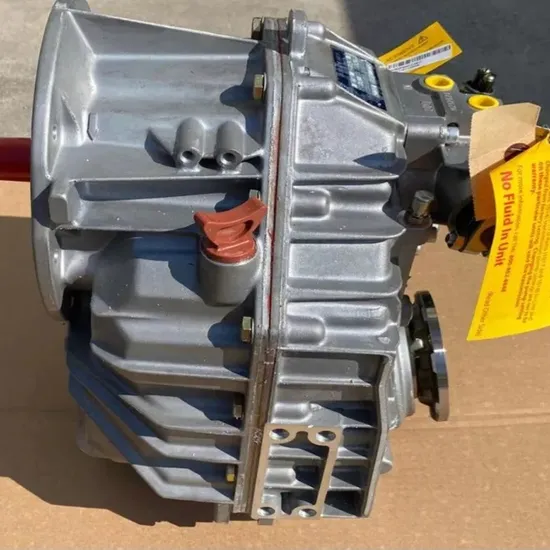
Check Forward, Neutral, and Reverse
Where testing is possible, verify:
- Forward engagement
- Neutral
- Reverse engagement
- Selector movement
- Noise
- Slippage
- Delay
- Vibration
Testing needs to suit the gearbox design.
A mechanically operated small Technodrive transmission should not automatically be evaluated with the same procedures as a large hydraulically controlled ZF or Twin Disc gearbox.
Bench-Tested vs Load-Tested: This Distinction Matters
This is probably the most important Trustworthiness section in the article.
A seller says:
“Tested and working.”
Ask:
What test?
A proper load test is very different from simply rotating a gearbox on a bench. ZF’s official marine transmission overhaul and testing guidance explains that after a major overhaul, transmissions can undergo both function and load testing depending on the customer’s requirements. That is why we recommend asking exactly what a seller means when a used gearbox is described as “tested.”
Visual Inspection
Someone checked the gearbox externally.
Useful.
But not functional testing.
Manual or Bench Inspection
Shift mechanisms, shaft movement, leakage, or other functions may have been checked.
Better.
Still not necessarily representative of operating conditions.
Running Test
The gearbox may have been operated.
Ask:
- At what speed?
- With what oil temperature?
- For how long?
- Were pressures monitored?
- Was any load applied?
Load/Dynamometer Test
A proper load test evaluates transmission behavior while transmitting torque.
This can reveal information that a no-load test simply cannot.
ZF explicitly states that after major marine transmission overhaul, both function and load tests can be performed depending on requirements.
So remember:
“Tested” is not a complete test description.
Inspect the Clutch System
Different marine transmissions use different clutch designs.
You may encounter:
- Mechanical cone clutch
- Hydraulic multi-disc clutch
- Other manufacturer-specific arrangements
Potential warning signs may include:
- Slippage
- Delayed engagement
- Difficult shifting
- Noise
- Excessive heat
- Contaminated oil
But individual symptoms need proper diagnosis.
Do not declare an entire transmission bad from one observation without context.
Inspect the Oil Cooler and Cooling Circuit
Where fitted, inspect:
- Oil cooler
- Fittings
- Hoses
- Corrosion
- Blockage
- Leakage
- Evidence of water/oil cross-contamination
ZF identifies maintenance, repairs and overhauls as essential parts of marine-driveline support, which reinforces why cooling and lubrication components should be treated as part of the transmission system rather than accessories you ignore until failure.
Compatibility Matters as Much as Condition
Imagine you’ve found a beautiful used gearbox.
Oil looks good.
Shafts feel good.
No leaks.
Condition is excellent.
But it doesn’t fit your engine.
Then it is still the wrong gearbox.
You need to verify both:
Mechanical condition
and
propulsion compatibility.
Model-specific dimensions and installation data should come from current manufacturer documentation whenever possible. ZF’s Marine Product Selection Guide provides transmission specifications, dimensions, bellhousing information and installation drawings for its current marine products, illustrating why physical and mechanical compatibility should be checked from technical data rather than photographs alone.
Bellhousing and Flywheel Compatibility
Check:
- Housing size
- Adapter arrangement
- Flywheel
- Input coupling
- Damper plate
- Spline configuration
Do not assume the same horsepower means the same engine-to-gearbox interface.
Check the Damper Plate
The damper plate sits between the engine and gearbox and plays an important role in transmitting torque and managing torsional vibration.
Inspect:
- Splines
- Springs/components
- Cracks
- Wear
- Compatibility
Do not automatically reuse an old damper plate simply because it survived the previous gearbox failure.
Verify the Output Flange and Shaft Coupling
A replacement gearbox may connect perfectly to the engine while creating problems at the shaft.
Verify:
- Output flange diameter
- Bolt pattern
- Pilot
- Coupling
- Shaft arrangement
This is especially important when changing manufacturers.
Rotation Matters
Depending on the application, you may need to verify:
- Engine rotation
- Gearbox input requirements
- Forward output rotation
- Reverse output
- Propeller rotation
Twin installations deserve extra attention.
Port and starboard propulsion packages can have specific requirements.
Never assume rotation from appearance.
Measure Everything Before Shipping
International buyers especially should pay attention here.
Confirm:
- Overall length
- Width
- Height
- Mounting-foot spacing
- Input/output centerline
- Down-angle where applicable
- Weight
- Service clearance
A gearbox can be mechanically correct and still be unusable if it physically cannot fit the installation.
Technical compatibility + physical compatibility = actual compatibility.
Duty Rating Still Applies to Used Gearboxes
The gearbox being used doesn’t magically remove the manufacturer’s capacity limits.
You still need to match:
Engine power + RPM + ratio + duty
to the manufacturer’s rating.
ZF’s commercial marine transmission guidance, for example, explicitly positions different heavy-duty transmission families according to vessel and propulsion requirements rather than treating every gearbox as interchangeable across applications.
This becomes especially important for:
used commercial marine gearbox for sale
searches.
A transmission appropriate for pleasure-craft duty may not have the same allowable power rating in continuous commercial operation.
Practical Example: Used Technodrive TMC40P 2.60:1
Let’s make the process real.
Imagine you find a:
used Technodrive TMC40P 2.60:1 marine gearbox for sale
The photos look excellent.
The price is right.
Here is how we would approach it.
1. Verify Identity
Confirm the gearbox really is a TMC40P.
2. Verify Ratio
Confirm the forward reduction ratio is 2.60:1.
3. Record Identification
Photograph the serial/specification plate.
4. Check Intended Engine
Confirm:
- Engine model
- Horsepower
- Rated RPM
5. Check Duty
Pleasure vessel?
Charter?
Commercial?
6. Verify Input Arrangement
Check:
- Bellhousing
- Damper
- Input shaft
- Spline
- Mounting
7. Verify Output
Check flange and coupling.
8. Verify Controls
The TMC40P uses a mechanical operating arrangement, so control compatibility should be checked.
9. Inspect Condition
Evaluate:
Housing → corrosion → oil → shafts → seals → bearings → clutch
10. Measure It
Don’t trust visual similarity.
11. Understand the Test
Ask:
Was it visually inspected, bench-tested, run-tested, or load-tested?
12. Read the Terms
What warranty or return terms apply?
Only after those checks does:
“Certified used TMC40P 2.60:1”
become a useful purchasing description.
Used Twin Disc Marine Gearbox: What to Check
When evaluating a used Twin Disc marine gearbox for sale, verify:
- Exact MG model
- Serial number
- Forward/reverse ratio
- Engine rating
- Input RPM
- Duty
- Clutch system
- Controls
- Cooling
- Oil pressure where applicable
- Input/output condition
- Service history
- Testing
Do not search only for:
“used Twin Disc gearbox.”
Twin Disc offers many different transmission families.
Exact model matters.
Used ZF Marine Gearbox: What to Check
A used ZF marine gearbox for sale should be evaluated the same way.
Verify:
- Exact model
- Serial number
- Ratio
- Previous application
- Engine power/RPM
- Duty
- Oil
- Clutch engagement
- Controls
- Cooler
- Input interface
- Output flange
- Dimensions
ZF maintains dedicated marine diagnosis, maintenance, repair and overhaul services, which reinforces the value of model-specific service information rather than generic used-gearbox assumptions.
Used Advance Marine Gearbox
A used Advance marine gearbox for sale may be relevant for fishing boats, workboats, commercial vessels and other higher-duty applications depending on model.
Pay attention to:
- Previous vessel
- Duty
- Hours
- Lubrication
- Cooling
- Bearings
- Clutches
- Housing
- Controls
- Output arrangement
- Ratio
Commercial service history is not automatically a negative.
Undocumented condition is the bigger concern.
Used vs Certified Used vs Rebuilt vs Remanufactured vs New
Here is a useful way to compare them:
| Condition | What It Usually Means | What You Should Ask |
| Used | Previously operated | What is its history and current condition? |
| Inspected/Certified Used | Used and subjected to a stated inspection process | Who inspected it and what exactly was tested? |
| Rebuilt | Previously used and repaired internally | What components were replaced? |
| Remanufactured | Restored through a more comprehensive defined process | Who remanufactured it and to what process? |
| New | Unused | Is the specification correct for my application? |
The exact terminology may vary among sellers.
So never stop at the label.
Is a Used Marine Gearbox Worth Buying?
Yes—when the evidence supports the purchase.
A used gearbox becomes much more attractive when:
- Identity is verified
- Ratio is verified
- Capacity matches
- Duty is appropriate
- Condition is documented
- History is known
- Interfaces match
- Testing is clearly explained
- Price reflects condition
- Terms are clear
It becomes much riskier when you’re buying:
unknown model + unknown ratio + unknown history + unknown test + no return terms
That’s not bargain hunting.
That’s gambling with freight and installation labor.
Why the Cheapest Gearbox Can Cost the Most
Here’s a situation we want buyers to avoid:
Cheap gearbox
- international freight
- wrong ratio
- incompatible bellhousing
- new coupling
- propeller changes
- installation labor
- removal after failure
= very expensive cheap gearbox
That is why we encourage buyers to compare verified value, not only purchase price.
What Should Be Included With a Certified Used Gearbox?
Ask what actually accompanies the specific unit.
Depending on the listing, useful documentation may include:
- Identification
- Ratio
- Condition report
- Inspection details
- Testing details
- Photographs
- Included components
- Exclusions
- Warranty terms
- Shipping information
Do not assume every part visible in the photographs is included.
Ask about:
- Bellhousing
- Damper plate
- Cooler
- Mounts
- Coupling
- Controls
- Hoses
Warranty: Read the Actual Terms
A warranty is only as useful as the terms behind it.
Check:
- Duration
- Covered components
- Parts coverage
- Labor coverage
- Commercial-use exclusions
- Installation requirements
- Maintenance requirements
- Return procedure
- Freight responsibility
- Removal/reinstallation responsibility
Even manufacturer warranties normally contain installation, maintenance, rated-capacity and use conditions. Twin Disc’s published pleasure-craft warranty terms, for example, state that warranty protection can be affected by improper installation, maintenance, storage, modifications, or operation outside rated capacity.
So never interpret:
“comes with warranty”
as:
“every possible future cost is covered.”
Red Flags When Buying a Used Marine Gearbox Online
Be more cautious if you encounter:
- No identification plate
- Serial number withheld
- Reduction ratio unknown
- Only one distant photo
- No input-side photos
- No output-flange photos
- Fresh paint with no condition history
- Severe corrosion
- Unexplained weld repairs
- “Tested” with no test description
- Unknown reason for removal
- Unknown previous engine
- No duty/application information
- No dimensions
- Guaranteed fitment without asking about your engine
That final point is one of the biggest.
If a seller tells you:
“Yes, it fits.”
without asking:
Which engine? Which RPM? Which ratio? Which bellhousing? Which output flange? Which duty?
you should be asking more questions.
Not fewer.
Buying a Used Marine Gearbox for International Shipping
When the gearbox is traveling internationally, specification verification becomes even more important.
Before shipping, confirm:
- Model
- Ratio
- Serial/specification
- Condition
- Included components
- Dimensions
- Weight
- Packaging
- Freight method
- Delivery requirements
Critical components such as shafts, flanges, controls and exposed fittings should be protected properly during transport.
Getting the wrong gearbox across town is inconvenient.
Getting the wrong gearbox after ocean or air freight is much worse.
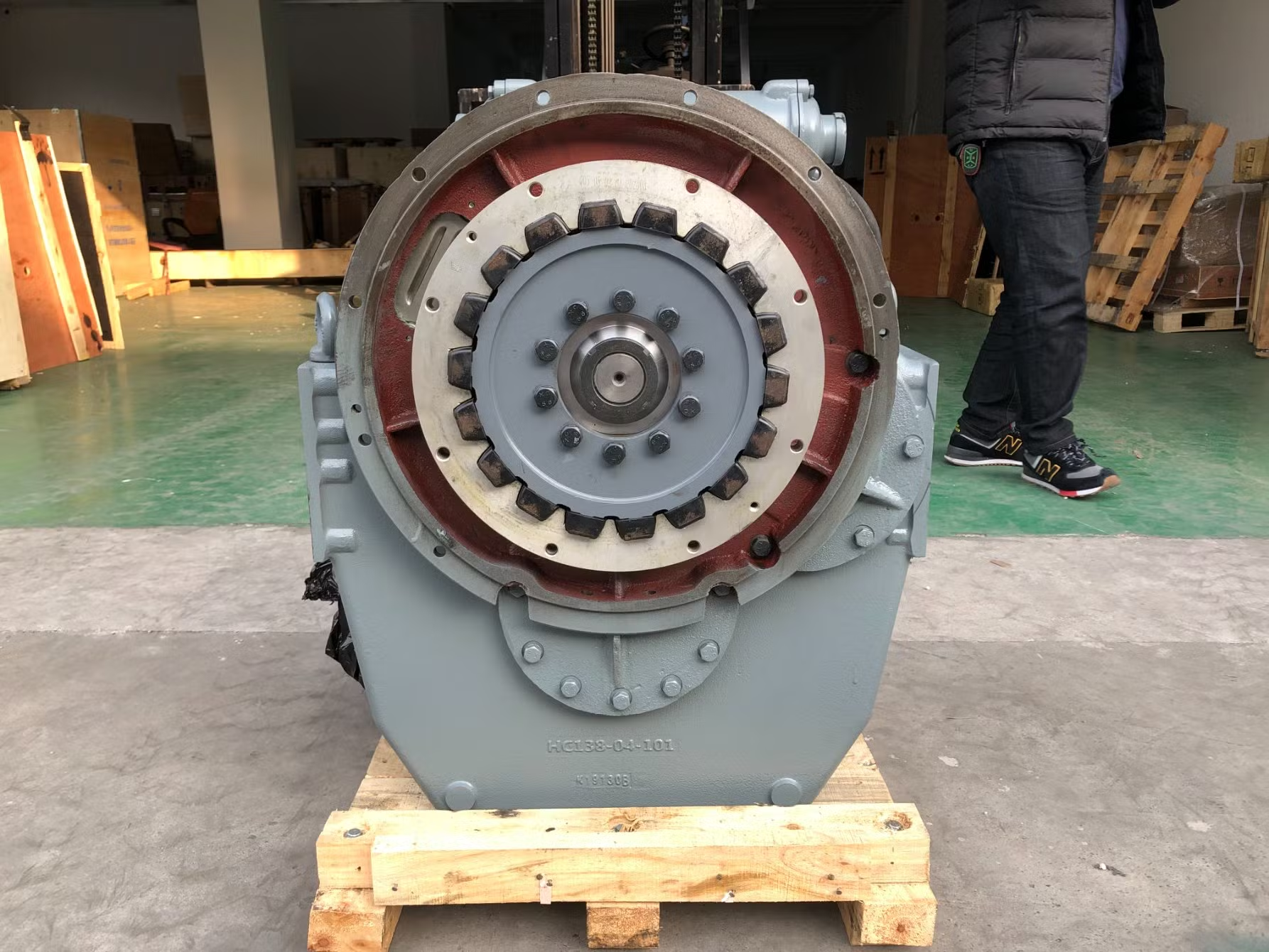
What Information Should You Send Power Engine Market?
When asking us to help identify a replacement marine gearbox, send:
- Engine manufacturer
- Engine model
- Rated horsepower/kW
- Rated RPM
- Existing gearbox manufacturer
- Gearbox model
- Forward ratio
- Nameplate photo
- Engine identification photo
- Full gearbox photo
- Bellhousing/input photo
- Output flange photo
- Vessel type
- Pleasure/commercial application
- Propeller details if known
- Shaft details if known
- Control type
- Existing dimensions/drawing where available
You don’t need to know all 18 things before contacting us.
Send what you have.
Then we can identify what is still missing.
We would rather ask for one more photo before shipping than discover one missing specification afterward.
How to Buy the Right Used Marine Gearbox From Power Engine Market
Our preferred process is straightforward:
Identify → Match → Inspect → Verify → Quote → Confirm → Ship
First, establish what your vessel currently has.
Then determine what replacement specifications are required.
Then evaluate the actual gearbox being offered.
Power Engine Market‘s Marine Gearboxes for Sale selection can include relevant Technodrive, Twin Disc, ZF Marine, Advance, and other marine transmission families depending on current availability.
Used inventory can change.
That is why condition, configuration, included components, test information and terms should be confirmed for the specific gearbox being purchased, not assumed from another unit of the same model.
Frequently Asked Questions About Certified Used Marine Gearboxes
Is it safe to buy a used marine gearbox?
It can be, provided the gearbox’s identity, condition, ratio, capacity and compatibility are properly evaluated. Unknown history or unclear testing increases risk.
What does certified used marine gearbox mean?
It should refer to a used gearbox evaluated under a defined inspection or verification process. Always ask who performed the certification and what inspection or testing was actually completed.
Is certified used the same as rebuilt?
No. A certified or inspected used gearbox may not have been internally rebuilt.
Is rebuilt the same as remanufactured?
Not necessarily. Remanufacturing usually implies a more comprehensive defined restoration process, while rebuild scope can vary significantly.
How many hours are too many?
There is no universal limit. Maintenance, loading, gearbox design, oil history, alignment, temperature and actual condition all matter.
What does milky gearbox oil mean?
It may indicate water contamination and should be investigated.
Does metal in gearbox oil mean the gearbox is bad?
Not automatically. The amount, type and source of metallic debris need proper evaluation.
What is the difference between bench-tested and load-tested?
A bench test may confirm basic mechanical or operating functions without reproducing actual torque load. A load test evaluates the gearbox while transmitting controlled power.
How do I know what ratio my gearbox has?
Check the gearbox identification plate or manufacturer documentation. Do not assume the ratio from model family alone.
Can I replace a 2.00:1 gearbox with a 2.60:1?
Potentially, but it changes shaft RPM and may affect propeller matching and engine loading. It is not automatically a direct replacement.
Does a used gearbox need a new damper plate?
Not always, but the existing damper should be inspected and its compatibility verified.
Can a ZF gearbox replace a Twin Disc transmission?
Potentially, but capacity, ratio, input interface, output connection, controls, cooling, dimensions and other installation details need to be checked.
Can I buy a used Technodrive TMC40P?
Yes, used TMC40P units may be available in the market, but verify model, ratio, condition, duty suitability and actual testing before purchase.
Do used marine gearboxes come with warranty?
Some do. Some don’t. Always confirm the warranty that applies to the specific unit.
Where can I buy a certified used marine gearbox online?
Power Engine Market supplies marine gearboxes for sale and can help buyers determine appropriate replacement specifications using their existing gearbox, engine, ratio and vessel information. Availability of individual used units varies.
Final Verdict: Buy the Evidence, Not the Paint
If you’re comparing a certified used marine gearbox for sale, don’t let appearance make the decision for you.
A clean gearbox is not automatically healthy.
A dirty gearbox is not automatically worn out.
Low hours don’t guarantee condition.
High hours don’t automatically condemn the transmission.
Fresh paint isn’t certification.
And:
“tested” does not automatically mean load-tested.
Instead, work through:
Identity → History → Inspection → Testing → Rating → Ratio → Compatibility → Terms
If those pieces line up, a used gearbox can make excellent financial and mechanical sense.
If half of them are unknown, the low purchase price may simply be the beginning of the bill.
At Power Engine Market, we recommend starting with the existing drivetrain.
Send us your:
gearbox nameplate + engine model + horsepower + rated RPM + reduction ratio + vessel application + installation photos
Whether you are replacing a Technodrive TMC40P 2.60:1, Twin Disc marine transmission, ZF Marine gearbox, Advance gearbox, or another marine gearbox, that information gives us a much better foundation for matching the correct replacement.
We would rather verify another specification before the sale than leave you discovering incompatibility after delivery.
Browse Marine Gearboxes for Sale at Power Engine Market or contact us with your engine and gearbox information for replacement-matching assistance.
Next Post: Marine Gearbox Matching Guide for Sale: How to Match Engine, Ratio & Propeller


