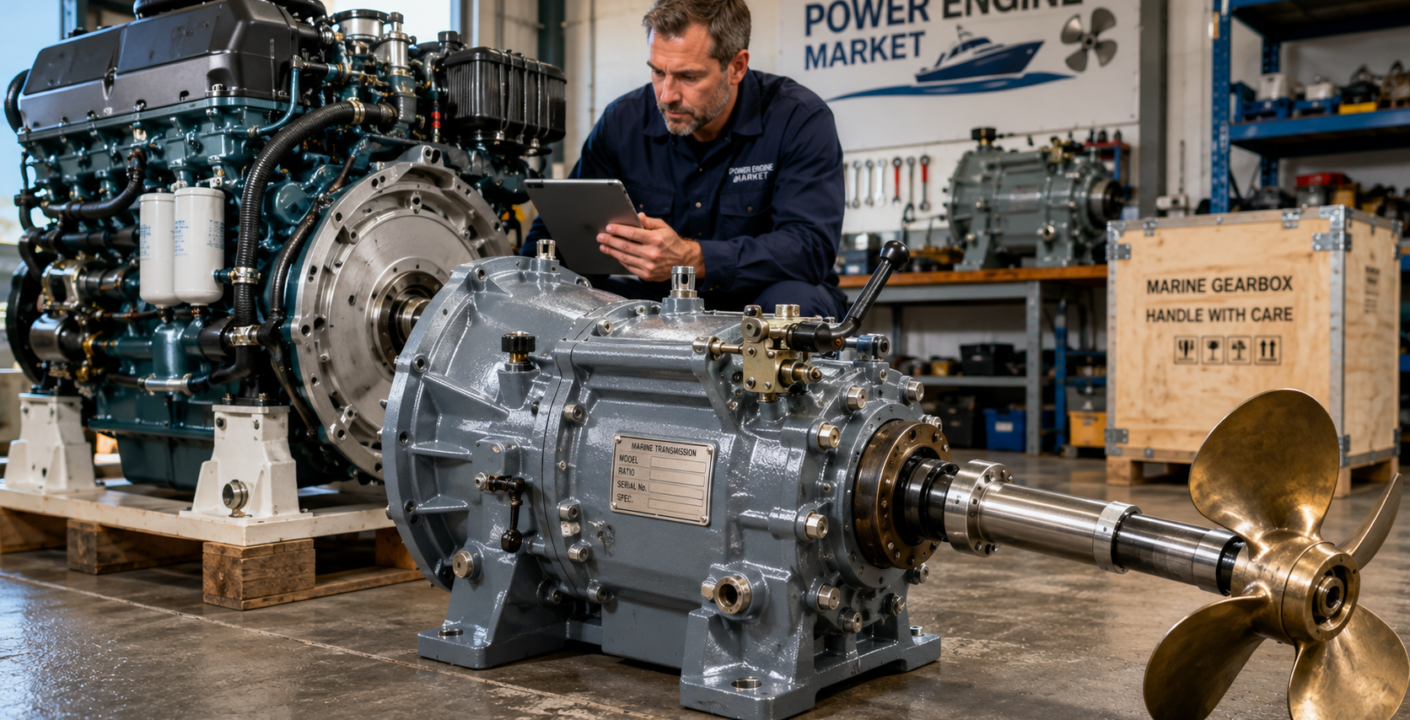
If you’re looking for a marine gearbox matching guide for sale, chances are you’re not researching gearboxes for fun.
Something probably happened.
Your existing transmission failed. You’re repowering the boat. You’ve found a gearbox online that looks almost identical to yours. Or you’re standing in front of an engine and wondering:
“Will this gearbox actually fit?”
That sounds like a simple question.
It usually isn’t.
At Power Engine Market, the first thing we want buyers to understand is that a marine gearbox is not selected in isolation. It sits in the middle of a propulsion system where several components have to work together:
Engine → Flywheel & Damper → Marine Gearbox → Output Coupling → Propeller Shaft → Propeller → Vessel
That’s why horsepower alone cannot tell you which gearbox to buy.
Neither can the brand name.
Neither can a photograph.
And even seeing the same model number on two gearboxes does not necessarily mean you should order one without checking the ratio and configuration.
A properly matched marine transmission for sale needs to suit the engine’s power and rated RPM, gearbox duty classification, reduction ratio, input arrangement, output connection, controls, shaft requirements, propeller and vessel application.
If you’re replacing an existing gearbox, there is one thing you can do before anything else:
Take a clear photograph of the nameplate.
We’ve found that a good nameplate photo, combined with the engine model and a few installation pictures, can answer questions that ten back-and-forth messages cannot.
So let’s go through exactly how we approach marine gearbox matching.
How Do You Match a Marine Gearbox to an Engine?
A correct marine gearbox match starts with the exact engine specification.
We want to establish:
- Engine manufacturer and model
- Rated horsepower or kilowatts
- Rated engine RPM
- Intended vessel duty
- Required gearbox reduction ratio
- Existing bellhousing/flywheel interface
- Damper plate and input arrangement
- Output flange and shaft coupling
- Control system
- Installation dimensions
- Propeller and shaft requirements where relevant
Then we compare those requirements against the gearbox manufacturer’s published ratings.
This last part matters.
A transmission may have very different allowable engine-power ratings depending on input RPM and duty classification.
For example, Twin Disc publishes separate ratings for pleasure, intermediate and continuous-duty applications on its MG-340/TMC 40 P family. The same gearbox does not simply have one universal horsepower number stamped against every application.
That is why a seller telling you:
“This gearbox handles 35 HP.”
without also considering ratio, RPM and duty may not be giving you enough information.
What Does a Marine Gearbox Actually Do?
A marine gearbox does more than put the boat into forward and reverse.
It performs several important jobs.
It transfers engine power into the propeller shaft, allows neutral and reversing operation, and—on reduction gearboxes—reduces the rotational speed reaching the shaft.
That last function is critical because the engine and propeller usually do not want to operate at the same RPM.
Engine RPM and Propeller Shaft RPM Are Different
Suppose your diesel engine is operating at:
3,000 RPM
With a 2.00:1 reduction gearbox, approximate output-shaft speed is:
3,000 ÷ 2.00 = 1,500 RPM
Now consider a 2.60:1 reduction gearbox:
3,000 ÷ 2.60 ≈ 1,154 RPM
The engine hasn’t changed.
But the propeller shaft is now turning about 346 RPM slower.
That difference can be significant because propeller diameter, pitch, blade area, shaft loading and engine loading all interact with shaft speed.
So when someone asks:
“Can I replace my 2:1 marine gearbox with a 2.6:1 gearbox?”
we don’t want to answer from the bolt pattern alone.
We need to look at the propulsion system.
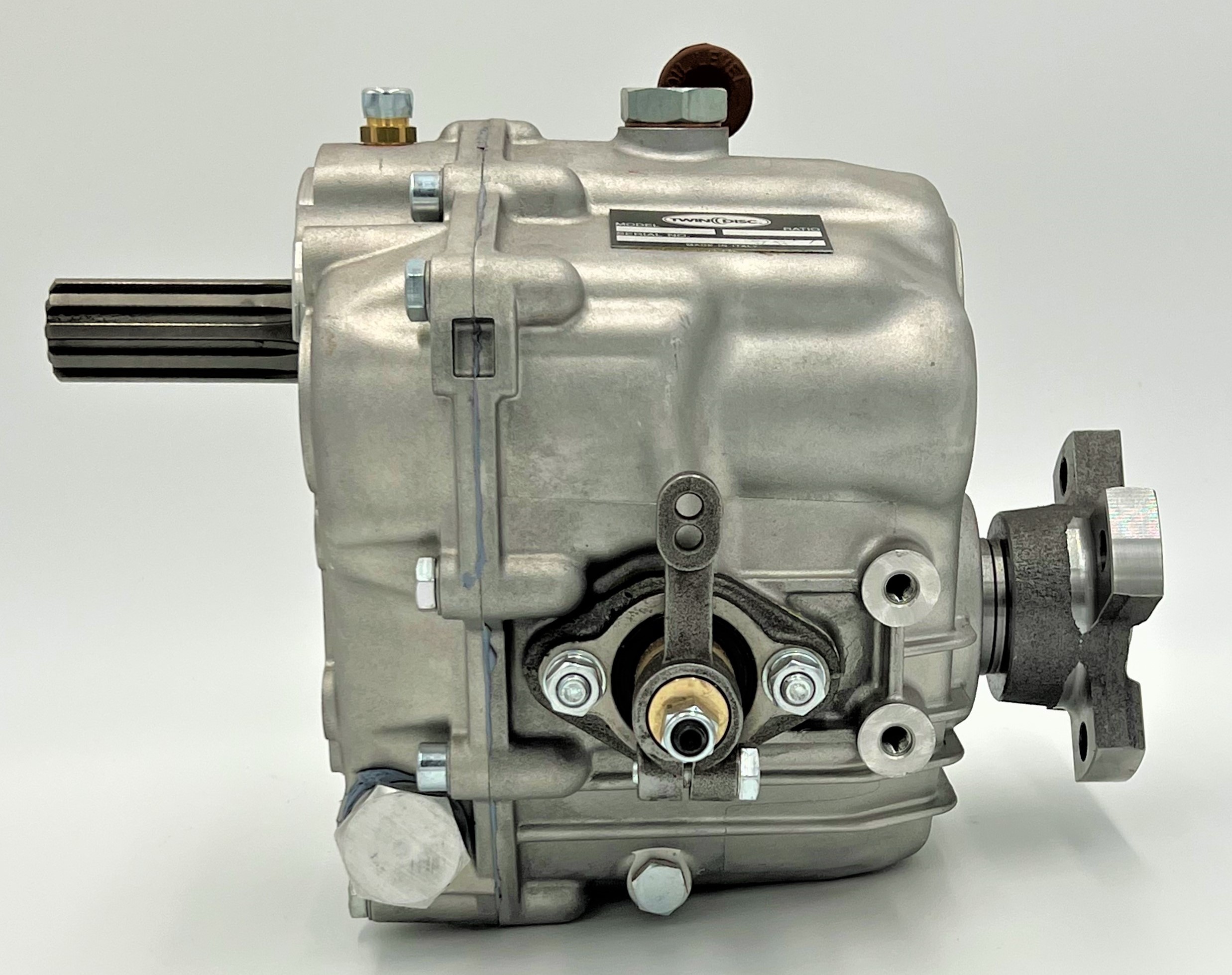
Start With the Marine Gearbox Nameplate
When you’re replacing an existing transmission, the nameplate is often the most useful starting point.
Depending on manufacturer and gearbox family, the plate may show:
- Manufacturer
- Model
- Serial number
- Forward reduction ratio
- Reverse ratio
- Specification/version
- Identification numbers
- Other manufacturer-specific data
Notice that I said forward and reverse ratio.
That’s another reason not to simplify gearbox identification too aggressively.
For example, the official Twin Disc TMC40P/MG-340 specifications list forward ratios of 1.45:1, 2.00:1 and 2.60:1, with a published reverse ratio of 2.13:1 for these configurations. This is a good example of why the complete ratio specification matters when identifying a replacement transmission.
So if you send us:
“I need a TMC40P.”
that’s useful.
But:
“I have a TMC40P with 2.60:1 forward reduction, and here is the identification plate.”
is much better.
Photos That Help Us Match a Replacement Gearbox
When contacting Power Engine Market, send:
- Clear nameplate photograph
- Full gearbox photograph
- Engine identification plate
- Engine-to-gearbox connection
- Bellhousing/input side
- Output flange and shaft coupling
- Mounting feet
- Shift/control connection
- Cooling connections where applicable
- Any existing dimensional drawing
Don’t worry if the old gearbox is dirty or corroded.
We’re not judging the photography.
We are looking for information.
How to Read a Marine Gearbox Reduction Ratio
Reduction ratios become easy once you stop treating them like mysterious transmission codes.
What Does 2.00:1 Mean?
A 2.00:1 reduction means the input turns approximately twice for every one output revolution.
At 3,000 engine RPM:
3,000 ÷ 2.00 = 1,500 output RPM
What Does 2.60:1 Mean?
At the same 3,000 engine RPM:
3,000 ÷ 2.60 ≈ 1,154 output RPM
Basic Marine Gearbox Ratio Calculation
Use:
Approximate Shaft RPM = Engine RPM ÷ Forward Reduction Ratio
For example:
| Engine RPM | Forward Ratio | Approx. Shaft RPM |
|---|---|---|
| 3,000 | 1.45:1 | 2,069 RPM |
| 3,000 | 2.00:1 | 1,500 RPM |
| 3,000 | 2.14:1 | 1,402 RPM |
| 3,000 | 2.47:1 | 1,215 RPM |
| 3,000 | 2.60:1 | 1,154 RPM |
| 3,000 | 2.63:1 | 1,141 RPM |
| 3,000 | 3.00:1 | 1,000 RPM |
This is useful when you’re comparing marine gearbox reduction ratios.
But don’t mistake this formula for a complete gearbox or propeller-selection calculation.
It tells you shaft speed.
It does not tell you whether the transmission capacity, propeller, duty rating or installation is correct.
Why Gearbox Ratio Matters to Propeller Selection
The gearbox and propeller are connected mechanically, so changing one can affect what the other needs to do.
A larger numerical reduction ratio usually means lower shaft RPM for the same engine RPM.
That can change the propeller requirements.
Relevant variables include:
- Propeller diameter
- Pitch
- Blade count
- Blade area
- Shaft speed
- Available engine power
- Hull form
- Vessel displacement
- Propeller clearance
Propeller Diameter
Diameter affects how much water the propeller interacts with.
But you cannot just increase diameter endlessly because the hull, shaft geometry and required tip clearance impose physical limits.
Propeller Pitch
Pitch is part of how far the propeller theoretically advances per revolution.
Again, it doesn’t work alone.
A propeller with the wrong diameter and pitch combination can overload the engine even if the gearbox itself is perfectly matched.
This Is Why Ratio Changes Need Thought
Suppose a boat currently performs correctly with:
Engine → 2.00:1 gearbox → existing propeller
and you install:
Engine → 2.60:1 gearbox → same propeller
The shaft now turns considerably slower.
That doesn’t automatically mean the combination will perform correctly.
The propeller may need reassessment.
So if you’re researching how to choose a marine gearbox reduction ratio, start by thinking of the ratio as one part of a system—not an isolated preference.
Can You Replace a 2.00:1 Gearbox With a 2.60:1?
Possibly.
But that should not automatically be described as a direct replacement.
If the old drivetrain was operating correctly and you’re simply replacing a damaged gearbox, matching the original reduction ratio is often the safest starting point.
Changing from 2.00:1 to 2.60:1 changes:
- Propeller shaft speed
- Torque multiplication at the shaft
- Propeller operating conditions
- Potential engine loading
- Vessel performance
A ratio change can make sense in a properly engineered repower or propulsion change.
It just needs a reason.
“The 2.60:1 was cheaper” is not a propulsion-engineering reason.
Match the Gearbox to Horsepower AND RPM
This is where buyers often make their first big mistake.
They search:
marine gearbox for 30 HP diesel
and assume every 30 HP gearbox is interchangeable.
It isn’t that simple.
The gearbox input rating depends on factors that can include:
- Engine power
- Input speed
- Reduction ratio
- Duty classification
- Manufacturer rating methodology
Twin Disc’s own current TMC 40 P data makes this easy to see.
For the 2.60:1 configuration, published allowable power varies depending on whether the application is pleasure craft, intermediate or continuous duty and on input RPM.
That means asking:
“How much horsepower does the gearbox handle?”
is incomplete.
Ask instead:
“What engine power is this gearbox rated to accept at my engine RPM, chosen ratio and duty classification?”
That is a much better buying question.
This is why we recommend checking the manufacturer’s marine transmission selection and rating data rather than choosing a gearbox from horsepower alone. Twin Disc’s selection information considers engine power at RPM and application duty, reinforcing why the same transmission cannot be assigned one universal horsepower limit for every vessel and operating profile.
Duty Rating Can Change the Entire Match
This is one of the most important pieces of the article.
A transmission that works behind an engine in a pleasure boat may not receive the same allowable rating for continuous commercial operation.
Twin Disc’s current marine product guidance defines distinct usage profiles and specifically recommends matching transmission ratings to the engine’s published rating for the intended application.
Pleasure Craft
Think private recreational use with relatively low annual hours and limited full-throttle operation.
Light or Intermediate Duty
Depending on manufacturer definitions, these categories may cover vessels accumulating more operating hours and spending more time at meaningful engine loads.
Continuous or Commercial Duty
This is where workboats and other applications may spend prolonged periods under load.
The terminology isn’t identical across every manufacturer.
That’s why we don’t recommend memorizing one universal table and applying it to every brand.
Use the actual manufacturer data for the transmission you are buying.
Why We Ask What Kind of Boat You Have
If you contact us and say:
“The engine makes 30 HP.”
we still need to know whether you’re putting the transmission into:
- Private sailing yacht
- Charter boat
- Fishing vessel
- Workboat
- Commercial launch
- Other high-hour application
That’s not us asking unnecessary questions.
That is part of gearbox matching.
Real Example: Technodrive TMC40P 2.60:1
Let’s use a real product example.
Suppose your existing gearbox is a:
Technodrive TMC40P 2.60:1
and you want a new replacement.
At first, this sounds straightforward.
Same model.
Same ratio.
Done.
But we still verify.
Step 1: Check the Existing Identification Plate
Confirm that the old unit is actually a TMC40P/MG-340 family transmission and confirm the ratio.
Twin Disc currently identifies the MG-340 as the Technodrive TMC 40 P. It uses a mechanically operated conical clutch and is available with several reduction ratios.
Step 2: Confirm the Engine
We want:
- Engine manufacturer
- Exact model
- Rated HP/kW
- Rated RPM
This matters because Twin Disc’s allowable TMC40P ratings vary with ratio, RPM and duty.
Step 3: Confirm Duty
Is it recreational?
Intermediate-duty?
Continuous commercial service?
Don’t skip this.
Step 4: Check Engine-Side Interface
Twin Disc lists interface options for the TMC40P/MG-340 including Borg Warner housing and SAE J617 no. 5 housing, along with a spring damper plate and control cable bracket options.
Your actual installation still needs to be checked.
Step 5: Verify Output-Side Compatibility
Check:
- Output flange
- Shaft coupling
- Alignment
- Shaft geometry
Step 6: Check Physical Dimensions
The TMC40P is compact, but we still compare dimensions.
Never use a photo as a measuring tool.
Step 7: Check Controls
Verify shift arrangement and cable/control compatibility.
Step 8: Check Cooler and Connections Where Applicable
Installation details matter.
Step 9: Decide Whether It Is Truly Plug-and-Play
Only now do we use that phrase confidently.
For us, plug-and-play marine gearbox replacement should mean that the important specification and installation interfaces have actually been checked.
It should not mean:
“Same color, same shape, probably fine.”
“It Bolts Up” Is Not the Same as “It Is Correctly Matched”
This deserves its own section because it causes so many mistakes.
Imagine a gearbox connects physically to your engine.
Great.
But what if:
- Capacity is wrong?
- Ratio is wrong?
- Duty rating is insufficient?
- Output flange differs?
- Control system doesn’t match?
- Rotation requirements conflict?
- Propeller no longer suits the shaft RPM?
It may physically bolt on and still be the wrong transmission.
So when evaluating a replacement marine gearbox for sale, check both:
Mechanical fit
and
propulsion suitability
You need both.
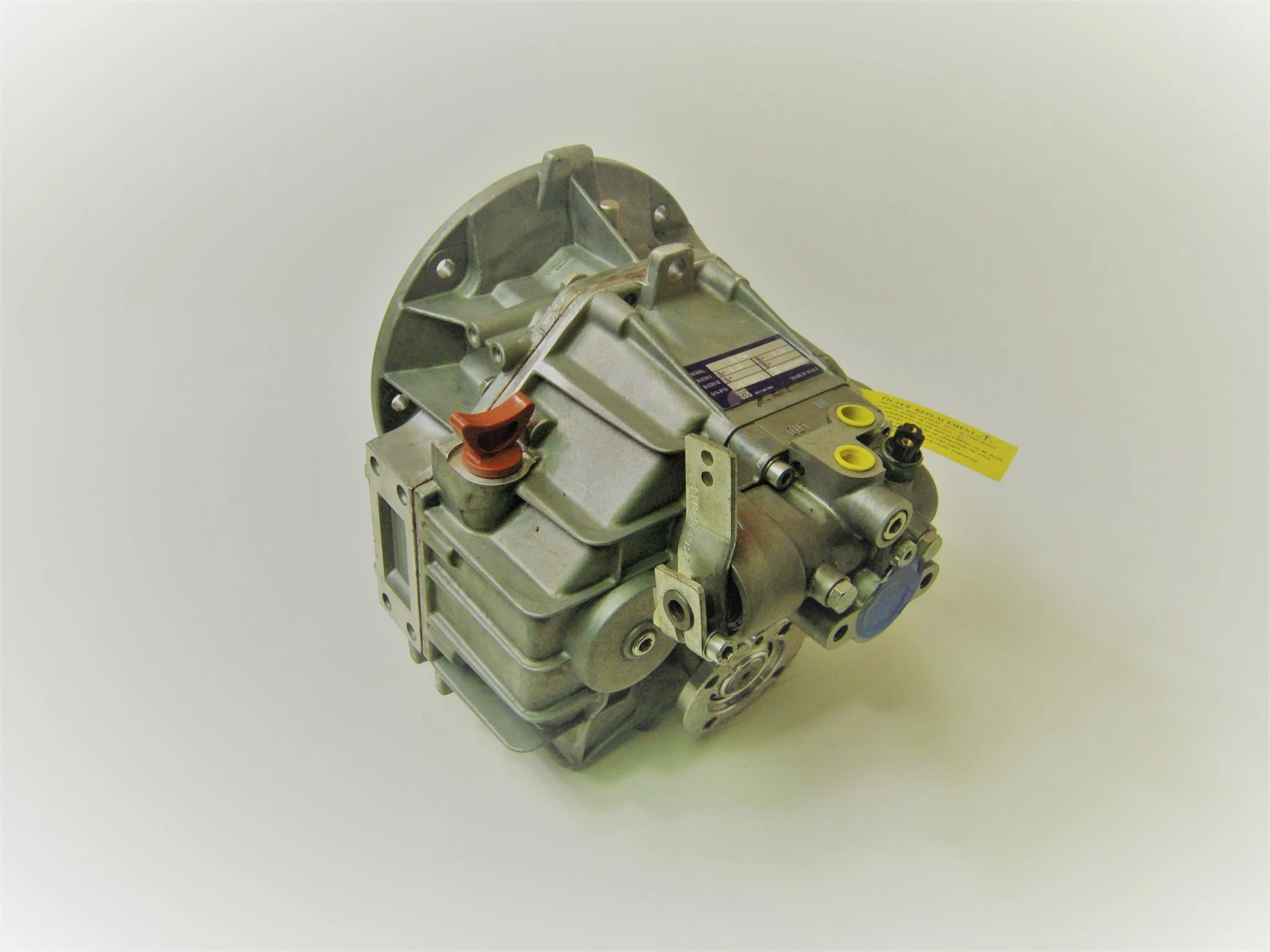
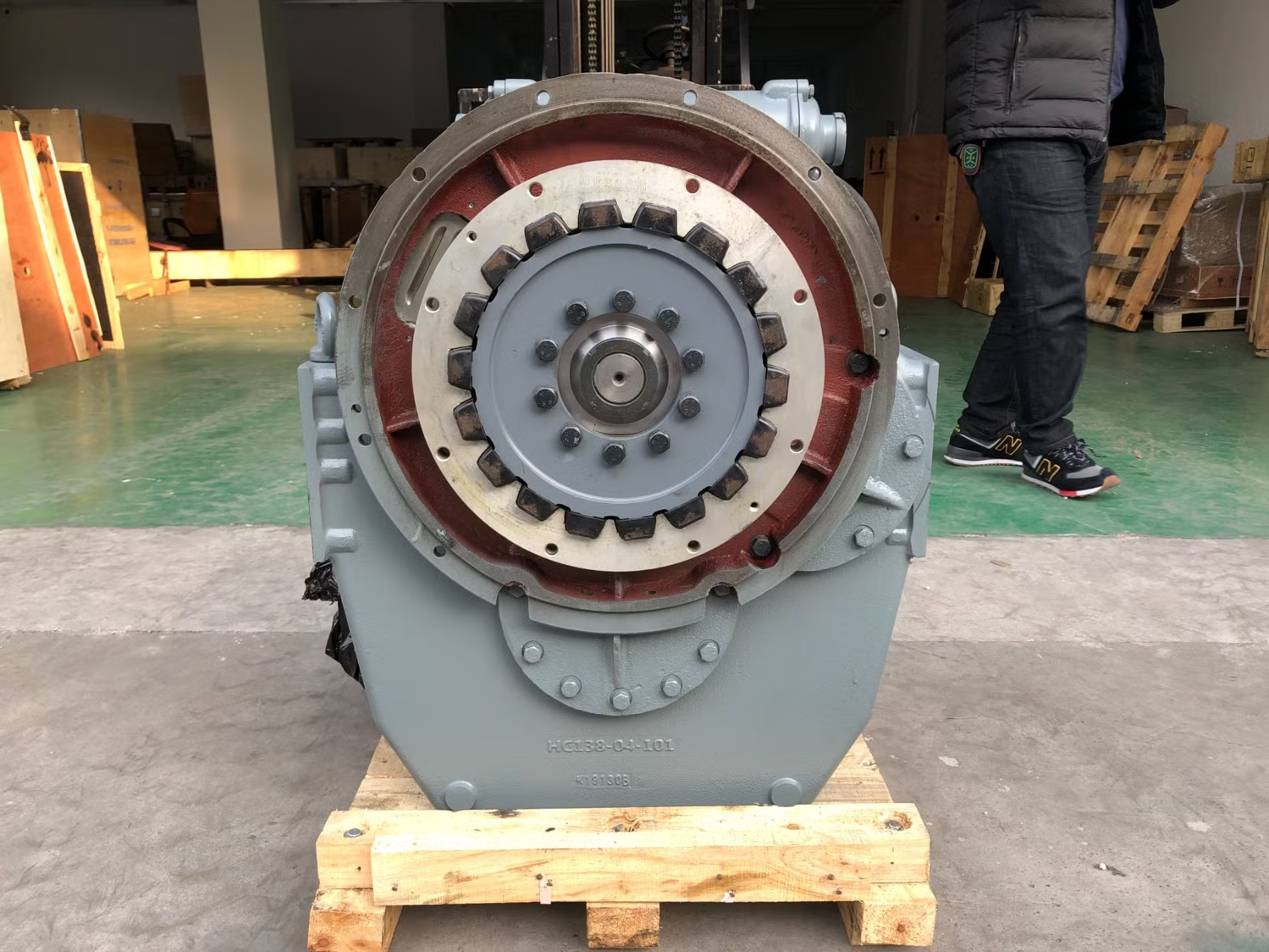
Bellhousing, Flywheel and Damper Plate Compatibility
Let’s move to the engine side.
Bellhousing
The bellhousing provides the physical interface between the engine and transmission. Some marine drivetrain combinations use standardized SAE flywheel housing dimensions under SAE J617, while others may involve manufacturer-specific interfaces or adapters. Never assume compatibility from engine horsepower or gearbox appearance alone.
Depending on the engine and gearbox, you may encounter SAE-standard or manufacturer-specific arrangements.
Twin Disc notes that some of its marine transmission input couplings are configured around engine flywheels conforming to SAE J620, and its product guidance advises consulting the manufacturer where non-standard flywheels are used.
Flywheel
Flywheel dimensions and interface matter.
Don’t assume compatibility just because the engine horsepower is correct.
Damper Plate
The damper plate helps transmit torque while managing torsional vibration between the engine and gearbox.
This component deserves respect.
Twin Disc specifically warns that ignoring torsional compatibility can damage drivetrain components and, at minimum, may cause gear clatter at low speed.
So when replacing a gearbox, don’t automatically reuse the existing damper because “it still looks good.”
Confirm suitability.
Input Configuration
Spline dimensions and the actual gearbox input arrangement also matter.
This is why detailed photos and part identification are useful.
Output Flange and Propeller Shaft Compatibility
Now move to the back of the gearbox.
You need to verify:
- Output flange
- Bolt pattern
- Companion flange where applicable
- Shaft coupling
- Shaft alignment
- Shaft diameter/arrangement
This matters particularly when changing gearbox brand or replacing an obsolete transmission with a modern alternative.
You could find the perfect engine-side transmission and still discover the output coupling needs modification.
That’s not necessarily a deal-breaker.
It just means it wasn’t truly a bolt-in replacement.
Parallel and Down-Angle Marine Gearboxes
Vessel geometry influences gearbox selection too.
Parallel/Inline Arrangements
These are suited to propulsion layouts where engine and shaft geometry align with the gearbox design.
Down-Angle Marine Gearboxes
A down-angle marine gearbox for sale may be appropriate where the transmission output needs to accommodate the shaft-line angle.
Twin Disc, for example, offers models with defined down-angle output configurations within its larger transmission range.
That can help vessel designers and repower installers solve packaging problems in tighter engine rooms.
But again, angle is not something to guess from photographs.
Use the drawing.
Mechanical, Hydraulic and Electronic Control Systems
The gearbox casing gets most of the attention.
Controls don’t.
Until installation day.
Depending on the marine transmission, shifting may involve:
- Mechanical cable operation
- Hydraulic actuation
- Electric/hydraulic controls
- Integrated electronic control systems
The TMC40P/MG-340, for example, is a mechanically operated transmission with a mechanically actuated conical clutch arrangement.
If you’re replacing a gearbox with something from another family, check the controls early.
Not after the engine is already back in the boat.
Engine Rotation and Output Rotation
Rotation requirements can matter as well.
This is especially important on twin-engine vessels.
You may need to establish:
- Engine flywheel rotation
- Permitted transmission input rotation
- Forward output direction
- Reverse output direction
- Port/starboard propeller requirements
Twin Disc notes that its published TMC40P ratings apply to standard right-hand rotation engines, illustrating why rotation is part of the manufacturer’s specification rather than something to assume.
For twin-engine installations, send information for both drivetrains.
Best Marine Gearbox Families to Consider
Once the technical requirements are clear, shopping becomes much easier.
Power Engine Market’s Marine Gearboxes selection allows buyers to compare appropriate gearbox families by application rather than choosing from appearance alone.
Technodrive Marine Gearboxes
Technodrive marine gearboxes are relevant to a range of compact marine propulsion systems.
A particularly useful product family for this guide is the Technodrive TMC40P, because it demonstrates exactly why reduction ratio and duty matter.
Available forward ratios include:
- 1.45:1
- 2.00:1
- 2.60:1
Twin Disc’s current specification tables show different allowable power figures across those ratios, RPM ranges and service classifications.
This is the perfect example of why:
Model name alone ≠ complete gearbox match.
Twin Disc Marine Transmissions
For larger engines and more demanding applications, Twin Disc offers a much broader marine-transmission range.
Twin Disc currently states that it produces more than 100 marine transmission models spanning roughly 35 to more than 4,000 horsepower, and its transmission selector asks users for engine output at RPM as well as duty type.
That is exactly the selection approach we recommend:
Power + RPM + duty + ratio + installation
not just horsepower.
ZF Marine Gearboxes
ZF marine gearboxes are also widely used across marine propulsion applications.
If you’re replacing another brand with ZF, verify the full interface rather than assuming the equivalent power class creates a direct replacement.
Check:
- Capacity
- Ratio
- Housing
- Input
- Output flange
- Controls
- Cooling
- Dimensions
Advance Marine Gearboxes
For commercial and higher-duty applications, an Advance marine gearbox may deserve consideration depending on the propulsion package.
Again, match the transmission to the actual vessel application and manufacturer’s rating data.
Can a ZF Gearbox Replace a Technodrive or Twin Disc Gearbox?
Potentially.
But “can replace” and “drops straight in” are different statements.
Changing brands may require checking or changing:
- Bellhousing
- Damper/input coupling
- Mounts
- Output coupling
- Overall length
- Shaft position
- Cooling
- Control hardware
- Oil lines
- Propeller ratio
There is nothing inherently wrong with changing gearbox brands.
Just treat it as a drivetrain conversion until you’ve proven otherwise.
New vs Rebuilt vs Used Marine Gearboxes
New Marine Gearbox
A new gearbox gives you:
- Known starting condition
- Manufacturer documentation
- Clear identification
- Applicable warranty terms
- No unknown operating history
For buyers prioritizing predictable condition, Power Engine Market’s new marine gearboxes for sale are the logical starting point.
Rebuilt Gearbox
A properly rebuilt transmission can be viable.
But ask:
- Who rebuilt it?
- What components were measured?
- What was replaced?
- What tolerances were checked?
- Was it tested?
- What warranty applies?
“Rebuilt” alone doesn’t tell you enough.
Used Marine Gearbox
If considering used equipment, investigate:
- Operating hours
- Vessel application
- Engine it previously ran behind
- Service history
- Oil condition
- Corrosion
- Bearings
- Seals
- Clutches
- Gear condition
- Identification plate
- Actual ratio
A cheap transmission is not cheap if you have to remove it again after 20 hours.
Common Marine Gearbox Matching Mistakes We See
1. Buying by Horsepower Alone
Horsepower matters.
So do RPM, ratio and duty.
2. Ignoring the Nameplate
Always photograph it before removing or discarding the old gearbox.
3. Assuming Every Ratio of the Same Model Has the Same Rating
The TMC40P itself shows why this assumption can be wrong.
4. Changing Ratio Without Reviewing the Propeller
Shaft RPM changes.
The propulsion system should be reassessed.
5. Ignoring Duty Classification
Private yacht use and commercial service are not automatically rated the same.
6. Assuming Similar Appearance Means Identical Dimensions
Use measurements and drawings.
7. Forgetting the Damper Plate
Torsional compatibility matters.
8. Checking Only the Engine Side
Output flange and shaft coupling matter too.
9. Ignoring Controls
You need to shift the transmission after installation.
10. Forgetting Rotation
Particularly important for twin installations.
11. Calling Something “Plug-and-Play” Before Verifying It
This is one phrase we prefer to earn.
12. Ordering Before Sending Available Photos
Ten clear photos cost nothing.
International return freight does.
What Information Should You Send Power Engine Market?
If you want help matching a marine gearbox for sale, send:
- Engine manufacturer
- Exact engine model
- Rated horsepower or kW
- Rated/max engine RPM
- Existing gearbox manufacturer
- Exact gearbox model
- Forward reduction ratio
- Gearbox serial/spec number where available
- Clear nameplate photo
- Full gearbox photos
- Engine identification photo
- Bellhousing/input photo
- Output flange/coupling photo
- Vessel type
- Pleasure or commercial use
- Propeller diameter and pitch if known
- Shaft diameter if known
- Control type
- Installation drawing/dimensions if available
You don’t have to know everything.
Send what you have.
We can tell you what information is still missing.
The key point is simple:
Good gearbox matching reduces assumptions.
And reducing assumptions reduces expensive mistakes.
Questions to Ask Before Buying a Marine Gearbox Online
Before paying for any replacement marine gearbox for sale, confirm:
Is this exact ratio correct for my application?
Is the transmission rated for my engine power at my rated RPM?
Which duty classification is being used?
Does the engine housing/flywheel interface match?
Is the damper plate compatible?
Does the input connection match?
Does the output flange match my coupling?
What rotation is supported?
Are the mounting dimensions correct?
Are the controls compatible?
Does it require an oil cooler?
What equipment is included?
What warranty applies?
Has the seller actually verified enough information to call it a direct replacement?
Those are the questions we’d rather answer before shipping than after installation starts.
How to Buy the Right Marine Gearbox From Power Engine Market
Our approach at Power Engine Market is straightforward:
Identify → Verify → Match → Quote → Confirm → Order
If you’re replacing an existing transmission, begin with the nameplate.
If you’re repowering, begin with the engine specification.
Then we work through:
Engine power → Engine RPM → Duty → Gearbox capacity → Ratio → Interface → Output → Controls → Dimensions → Shaft → Propeller
This allows buyers to move from a vague request such as:
“I need a gearbox for my diesel.”
to:
“I need a correctly matched replacement transmission for this engine and vessel.”
That’s a much safer buying position.
Frequently Asked Questions About Marine Gearbox Matching
How do I match a marine gearbox to my engine?
Use the exact engine model, rated power and RPM, then verify the gearbox manufacturer’s allowable input rating for the required reduction ratio and duty classification. After that, check housing, input, damper, output, controls, dimensions, shaft and propeller requirements.
What does a 2.60:1 marine gearbox ratio mean?
It means the input turns approximately 2.6 times for one output revolution. At 3,000 input RPM, output speed is approximately 1,154 RPM.
Can I replace a 2.00:1 gearbox with a 2.60:1 gearbox?
Possibly, but the change lowers shaft RPM and can affect propeller matching and vessel performance. It should not automatically be treated as a direct replacement.
Is a TMC40P 2.00:1 the same as a TMC40P 2.60:1?
No. They are the same gearbox family but use different forward reduction ratios, and Twin Disc publishes different allowable power figures depending on ratio, input RPM and duty.
How do I calculate propeller shaft RPM?
Divide engine RPM by the forward reduction ratio.
Does gearbox ratio affect propeller selection?
Yes. Ratio affects shaft RPM, which interacts with propeller diameter, pitch, blade area and engine loading.
Can I change gearbox ratio without changing my propeller?
Sometimes the existing propeller may still be appropriate, but you should not assume that. Reassess the propulsion system whenever the ratio changes significantly.
How do I identify my marine gearbox?
Locate the gearbox identification plate and photograph the complete model, serial/specification information and ratio.
Does a replacement gearbox need a new damper plate?
Not automatically, but the existing damper’s condition and torsional compatibility should be checked.
Is the Technodrive TMC40P a Twin Disc gearbox?
Twin Disc currently identifies the MG-340 as the Technodrive TMC 40 P in its product documentation.
What is marine gearbox duty rating?
It describes the operating profile under which the manufacturer rates the gearbox. Allowable transmission capacity can change between pleasure, intermediate and continuous-duty applications.
How do I know whether a gearbox is plug-and-play?
Confirm the exact model, ratio, capacity, duty, engine housing, damper/input, output flange, mounts, controls, cooling arrangements, dimensions and rotation requirements. Similar appearance is not enough.
Can another gearbox brand replace my existing transmission?
Potentially. But changing manufacturers usually requires a more complete interface and dimensional compatibility check.
Where can I buy a marine gearbox online?
Power Engine Market supplies marine gearboxes for sale, including relevant Technodrive, Twin Disc, ZF, Advance and other marine transmission options for recreational and commercial propulsion applications.
Final Verdict: Match the Propulsion System, Not Just the Gearbox
If you came to this guide asking:
“What gearbox fits my engine?”
we want you to leave asking:
“What gearbox correctly matches my engine, RPM, duty, ratio, shaft, propeller and vessel?”
That second question is much more likely to lead to the right transmission.
Remember the complete chain:
Engine → Flywheel & Damper → Gearbox → Reduction Ratio → Output Coupling → Shaft → Propeller → Vessel
The engine determines the power and speed entering the gearbox.
The manufacturer’s rating tells you whether the gearbox can accept that input under the intended duty.
The reduction ratio determines shaft speed.
The coupling and shaft transfer that output.
The propeller turns that rotational power into thrust.
And the hull determines what that thrust actually does for the boat.
That is why the best marine gearbox for sale is not automatically:
- The cheapest gearbox
- The largest gearbox
- The gearbox with the highest advertised horsepower
- The gearbox that looks like your old one
- Or even the gearbox that physically bolts onto the engine
The right marine gearbox is the one that has been correctly matched to the complete propulsion system.
If you’re replacing an existing Technodrive TMC40P 2.60:1, ZF marine gearbox, Twin Disc transmission, or another marine gearbox, start by sending Power Engine Market a clear photograph of the existing nameplate along with your engine model, rated horsepower, RPM, vessel application and installation photographs.
We would rather verify one more specification before you buy than discover one missing specification after the gearbox arrives.
Browse Marine Gearboxes for Sale at Power Engine Market or contact us with your engine and existing transmission details for gearbox-matching assistance.
Next Post: Portable Marine Generator for Sale: Best Models to Buy in 2026


